Bathgate is an Old Market town that lies on the central belt corridor of Scotland in the heart of West Lothian where the Black meets the Red. It has been the Birthplace and home to many famous people over almost a millennium, Including the Royal Stewart Dynasty.
The Town of Bathgate was at One time comprised of Five different Estates of the Five Big Houses of Bathgate. The Five B’s. These were of course Balbardie, Ballencrief, Boghead, Boghall and of Course Bathgate house itself.
The History of Bathgate
Early Origins
Bathgates Earliest known Inhabitants were around over 335 Million years ago. In 1987, Palaeontologists discovered fossils in the Bathgate Hills which lie to the Immediate North and Northeast of the Town. Westlothiana Lizzaeia, affectionately known as “Lizzie” was discovered and demonstrated the change in the areas geology over the duration of time.
The Area of Bathgate and its Hills to the towns North edge show proof of human habitation some Six Thousand years ago. The Megalithic Site of Cairnpapple demonstrates how these Stone age settlers used their stone cutting skills to erect Two Stone circles and dig a henge. The site also shows strong signs of use during the bronze age where the stone circle was reconstructed and used to build a burial mound. The area boasts many signs of these similar burial sites scattered all around the Bathgate area.
The Original Parish Settlement
However, the earliest Historical record of Bathgate was in 1190 in an order from David the First allocating the Land at Kirkton on the East side of the town to the Church who established the old Kirkton church which still stands in ruins today as part of its own cemetery. This established the Parish of ‘Bathket’ which means “Boar Wood”. The wooded hillside slopes of the Bathgate Hills immediately on the North Edge of Bathgate was a thickly wooded area that was home to a lot of boar and so would have made for a good place to settle for those who were up for the hunt as it was back in those days.
This early known settlement of Bathgate now lies more to the Eastern edge of the Town at Kirkton near to the old Boghall house which would later play an instrumental part in the towns makeup. Both Boghall and Boghead Estates which lie to the East and West of this Low lying strip of land were aptly named as this patch would have been a bog with the churchyard and setlement being on the more sturdy precipes of its edge.
A Royal Town
Standing like an Island in the Bog about a quarter of a mile West of the Kirkyard stood Bathgate Castle. It is possible that the area was strategically chosen for safty with the mushy bogland that had to be navigated to reach the castle would have served as a barrier against any stray boar or other undesriables of the wild woods who may take a hungry liking towards the settlement which is thought to have been built as a kinda hunting settlement and would later be used as a Royal Hunting Lodge.
You see, the Castle belonged to Walter the Steward who was a close companion of Robert the Bruce. When Bruce won at Bannockburn, he was able to bring his wife and young daughter Marjory back home to Scotland from Carlisle where they’d been held during their husband and fathers war with Edward II. The Bruce entrusted this Task to his high steward and Walter set South to Escort Marjory and Elizabeth home to King Robert the First of Scotland. However, the tale took a pleasant twist and both Walter and Marjory fell in love and would soon be married with the blessing and celebrations of Robert who was said to have been very delighted with the outcome. Bathgate castle was given to Walter from the King as a Dowry.
The Stewart Dynasty
So, it came to pass that the First Monarch of the Stewart Dynasty, Robert the Second was born and raised mostly in Bathgate. However, the young prince wasn’t born easy. His arrival into the world was prompted by tragedy. When Marjory was only 19 and heavily pregnant with Robert, she met with an accident and fell from her horse. Sadly, she died, but the baby was saved. So the First of the Stewart Monarchs never knew his mother as she died as he was born. This is perhaps a little different from the long succession of early Stewart Kings who never knew their fathers due to fate crowning them at a young age.
A Market Town
Throughout the centuries up til present day, Bathgate has been a busy little market town. Ever since its original foundation, the towns geographical position and Royal connection made the town a common rallying point and so flourished centuries of comings and goings as a busy little market town in the heart of the central belt between both cities of Glasgow and Edinburgh.
Bathgate is Once again a Market town after a decade or so without a market. The last Bathgate Market on the old car park site on Whitburn road closed in 2010 and was developed into Present day Lidl store. However, in 2022, a new Market site was opened behind the Argos store in the retail park on Whitburn Road.
A Mining Town
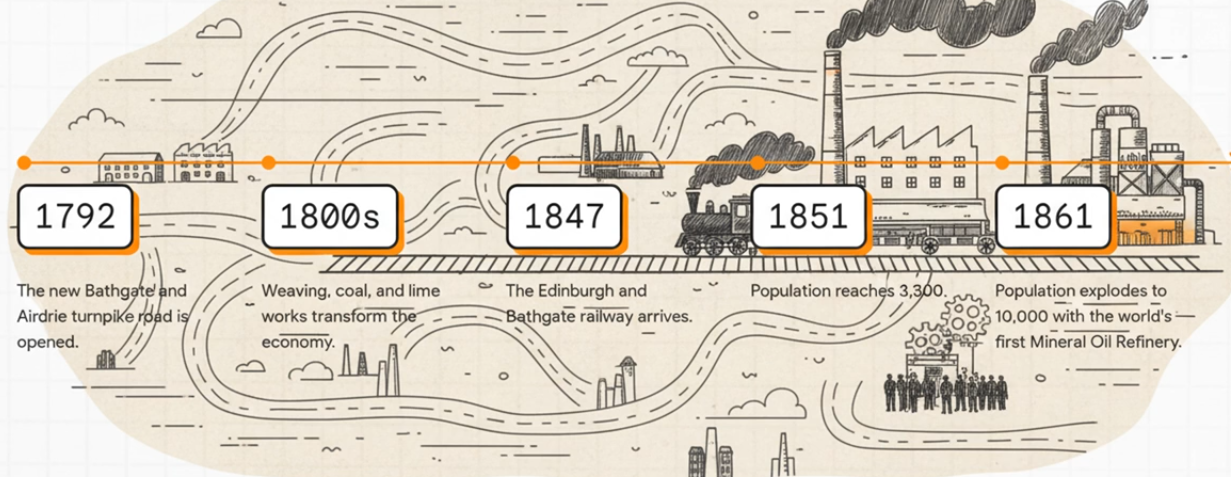
Throughout the Nineteenth and Twentieth century, Bathgate was also a busy mining Town. The Town itself had Two main collieries, Balbardie, which opened in 1855 and Easton which would later open in 1891. However, there were also a multitude of southern mining operations going on all around the neighbouring lands of the Town.
The Boghead Estate to the South West of the Town had many different Mining Operations with its very own unique ‘Boghead Coal’ which was more akin to Shale but with a Black Coal like colour and oily texture which made it a very rich source of Shale oil and was Instrumental in the discovery of Paraffin.
A Modern Town
In 1961, the British Motoring Company who later became British Leyland opened up their Tractor plant in Bathgate. This new Industrial enterprise created Jobs for 4000 people.This Twentieth century Industrial Enterprise would bring a lot of Families out from Glasgow which was having an Overspill. The plant lasted for 25 years til its closure 0n the 27th of June 1986. The plants closure resulted in over 2000 redundancies hitting the local economy pretty hard.
After a few years of recession, in 1992, American Cell phones manufacturer Motorola announced their opening of a new factory at Easter Inch, just a little bit from the Wester Inch Leyland Site. The Easter Inch Industrial Park can be seen from the M8 Motorway by its ornamental grass pyramids that is often known to sport coloured sheep and flower displays.
The branch would operate until 2001 when its workers were made redundant and Motorola left the UK due to the subsidy running out. The building was later used by the Inland Revenue then for a short time, a vaccination centre for the COVID-19 vaccination. Its now a Movie Studio.
Bathgate’s Historic Buildings
Bathgate is a very picturesque Town these days muchly due to the amount of beautiful Old historic buildings that are dotted around the town. Some of these buildings like the Old Bathgate Academy founded by New World entrepreneur John Newlands in 1799 and built in 1833 dominates the Bathgate skyline and has long time served as a prominent Landmark of the Town, being visible from miles around .
One Historic building in Bathgate well worth having a look at is The Bennie Museum just off Hopetoun street.
The Expansion of Bathgate
The evolution of the towns structure seems to shift around a fair bit over the centuries. As we know, the original settlement of Bathgate that we know of from the records was at Kirkton, now on the Eastern Edge of the Bathgate. Yet the towns Old Victorian and Edwardian “High Street” and “Main Street” now lie to the North West of the modern day Town centre towards the old Balbardie estate, indicating a significant shift from the Early settlements original location. It seems to have climbed the hill a little before settling back down to the bottom again where the Steelyard, the heart of the Town centre is situated.
Miners Houses
The towns housing estates paint a magnificent portrait of the Towns history. With the Industrial revolution brining mining to the town, workers settlements became housing estates such as Easton, Balbardie, Belvedere, Windyknowe,etc. The Chemical works on the Boghead estate where American chemist James Young invented Paraffin, had the village of Durhamtoun which would go on to be rebuilt as the towns Birniehill housing scheme.
The Glasgow Overspill
In the 1960s and 70s, the town would see a boom in council housing to cater for the influx of incoming population from Glasgow and Edinburgh cities. Although West Lothian at this time was filling up mainly from the Glasgow side as the overcrowded city was experiencing an overspill. Factories like the British Motoring Company plant in Bathgate’s Wester Inch just to the South edge of the Town by the Bog land that opened in 1962. It offered work to workers and their families who wanted to get out of the city and raise their families in a less stuffy environment than that of the city.
While the Newtown of Livingston was built to house a large number of these families, many of the neighbouring villages of West Lothian did their bit too and so did Bathgate. Estates like Boghall were built, almost doubling Bathgate in size. Although Bathgate and Boghall exist as Two separate Establishments now, the Boghall House Estate was still part of Bathgate’s make up and they’re pretty much joined together but for Kirkton recreation park which separates the Two for a short gap.
The People of Bathgate
The Town of Bathgate has been the home and Birthplace of many famous faces over the centuries.
David Tennant
The Scottish Actor most famous for his role as “the Doctor” in the BBC Sci Fi series Doctor Who was born and raised in Bathgate. Born David McDonald, his father was the minister in the Saint Davids church on George Street which is now the cinema.
George Alexander Ward
James Young Simpson
A very famous personality from Bathgate was James Simpson who was commonly known as “Young James” discovered Anaesthetic which would go on to the invention of Chloroform.
Paul Di Rista
Formula One Racing Champion Paul Di Rista was born and raised in Bathgate. His Father Louis was the owner of the towns well known night spot, The Palais which was originally the Old Corn Exchange Building.
Future Development
Today, the town of Bathgate yet continues to Grow. New housing is currently being built to the South West of the Town near Birniehill on the site of the old Abattoir opposite the site of the Old Durhamtoun Chemical works were Paraffin was Invented.