
Now, when you come over to the West Side of West Lothian and take a look at the bings, you’ll see that they are almost all black, as opposed to the red bings to the East Side of the district. This is because the area was almost all coal mining instead of shale. Although there was a couple of Shale bings on the area. These are mostly on the border where they mix into the Shale mining area of the Red East.
Coal Mining in West Lothian
Whitburn is the epicentre of Black West Lothian and it’s crossed road centre divides up the Four main Quarters of the Black West. These are Polkemmet Moor to the South West, Southrigg to the North West, Torbane to the North East and Blacksheils to the South East.
Throughout these Four Quarters, the whole areas were peppered with mine workings that pulled up coal. Many of these old workings have long since been levelled and left without a trace, being replaced mainly by Fields. But there are still many that can still be seen. Or at least, their mark on the land still remains in the form of the old bings. But what of the old pits and settlements that Once made this area such a bustling hive of Industrial pursuit back in the 19th century?
Early Coal Mining
In the Early to Mid 19th century, Black West Lothian, still green and pleasant was to see a dramatic change in its landscape. What had been an area of Green pastures or Runrig crofting and some Iron moining quickly became a Black Industrial haze. This was due to the discovery of coal in the area. This didnt take long for enterprise to fill the area.
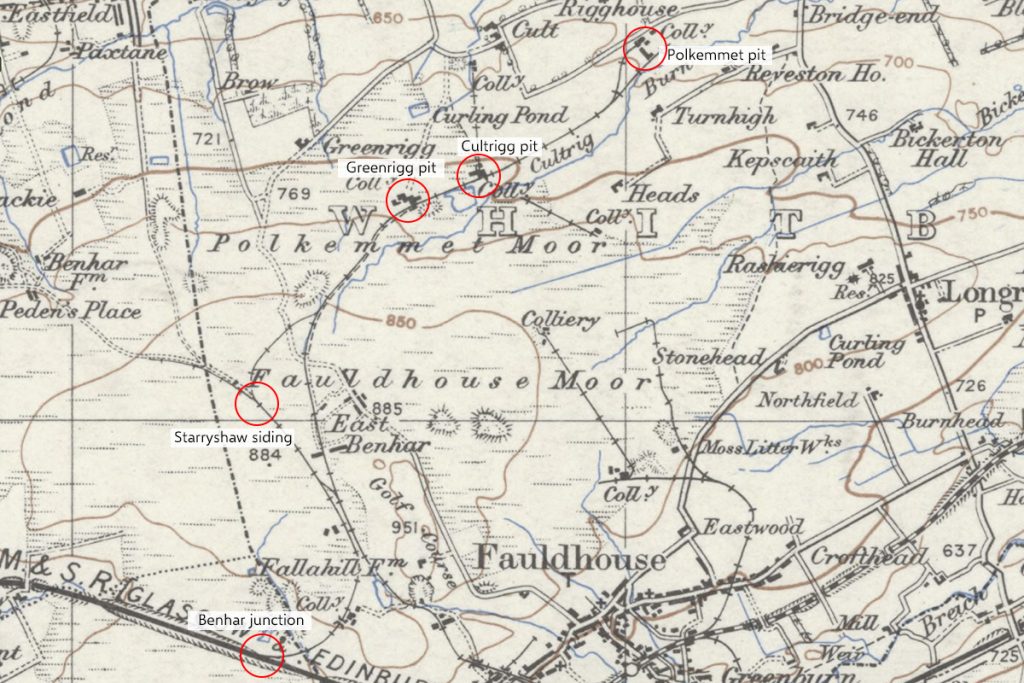
The early Coal mines were what were known as “Dixon” pits. These mining rigs were named after their designer, an engineer called William Dixon. In the original mining days of the 1800s, these Dixon Pits were scattered all over the area, many only a few hundred yards from each other. The town of Fauldhouse on the far South West corner of the shire originally had Five Pits belonging to the pit itself. Not to mention the numerous pits that surrounded the town and right across the Black West.
We can still see remnants of some of these Dixon mines in places like East Whitburn where the Old Whitrigg Pit still boasts its Bing. This is now a woodland with various footpaths on what once was railroad. But the Mine Head here is marked by a monumental Stone Wheel mosaic on the ground where the shaft has been capped off. We can see similar remnants near Stoneyburn and Addiewell which lie to the South East where it almost crosses over into the Red East.
Deep Shaft Mining
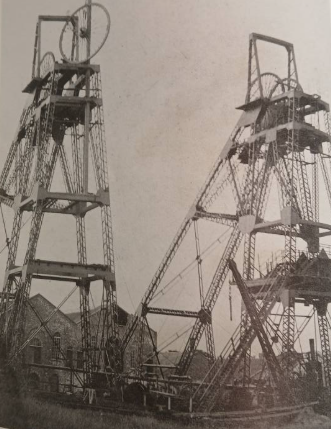
At the turn of the 20th century, coal mining underwent a period of Modernisation. This new era for the Industry saw the First Deep Shaft mines being sunk. The most famous of these pits in West Lothian was Polkemmet Colliery near Whitburn. Nicknamed “The Dardanelles”, this New Colliery which was sunk on Polkemmet moor would swallow up many of the earlier Dixon mines like Dumback, Greenrig, and many other small mining rigs that were in this area.
This new Deep Shaft mining would burrow deep under the whole Black West Lothian and had mine tunnels that stretched for miles around in various directions. These would work by tunneling a “Main Road” track burrowing into the coal face then a series of off shoot tunnels mining into the coal face. Of course, by this time they had electricity, so machinery was installed which assisted in creating the vast size of these pits.
This deep shaft mining would thrive throughout the Twentieth century until the 1980s when Britain saw dramatic changes including the closure of all coal mines in favour of cheaper coal from overseas. However, this came with quite a dramatic ending with a Year long Strike which would see the end of Coal mining in West Lothian.