
If you drive past Bathgate and Livingston on the M8 motorway, you will drive right through the site of what Once was the old mining Village of Starlaw. Once a fairly well populated little mining village built to facilitate the workers of the nearby Starlaw Shale mine, Boghall Chemical works and later the Deans Chemical works, the Village of Starlaw is alas no more. It is covered over by the Motorway and the roundabout that is the Starlaw Junction (M8 J4a)
The Lost Mining Village of Starlaw
Throughout West Lothian, there is said to be at least 20 such dwelling that were built hurriedly to cater for the Coal and Shale boom of the 19th century. Yet, with the decline of that once prosperous industry here in West Lothian, these settlements quickly fell into a desperate state and needed dealing with. Many of these ‘Ghost Villages’ like Starlaw here, have vanished with barely a trace. Whilst some of the more fortunate dwellings have found themselves incorporated into what is now the modern towns of West Lothian.
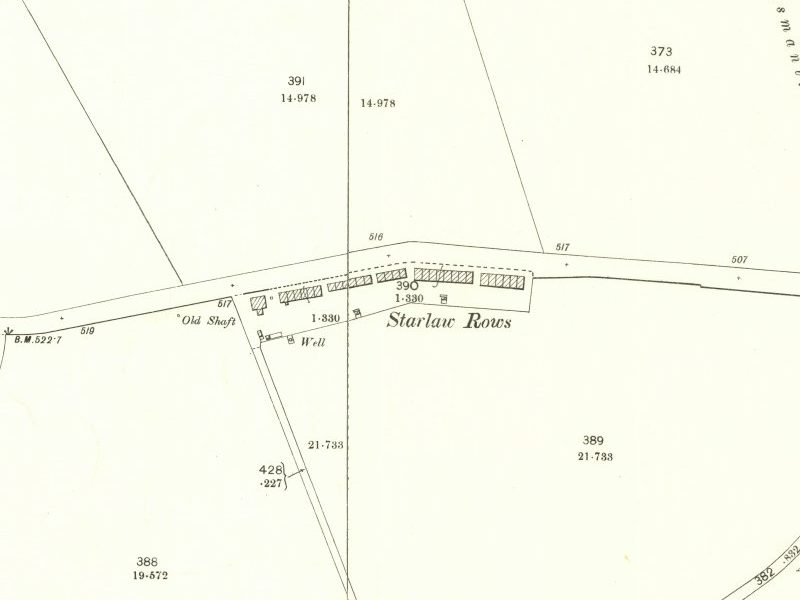
Sadly though for Starlaw, the only remnants we have of this once important little village are in the history books, records, old maps and photos, since the village itself has long since been cleared with modern developments like the Glasgow to Edinburgh motorway which now lies across the original site of Starlaw village.
But, at least we do still have historical records of this lost village, its people, its tragedies and alas, it’s fate. So lets have a wee look shall we?
Starlaw’s Early Foundations
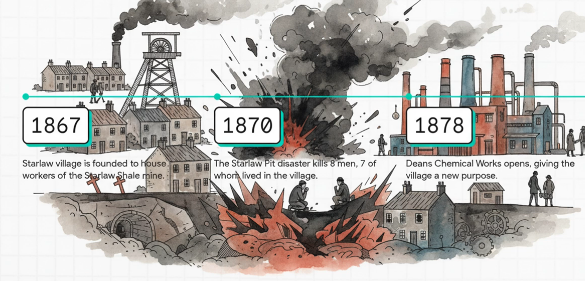
The Village of Starlaw was railed into existence in 1867 to house the workers of the Starlaw Shale mine which was essentially part of the village. It was One of many alike. With the Shale Boom of the Industrial revolution being born in West Lothian, alongside the coal mining of the time, settlements like these were commonplace. Thrown up quickly by the mining companies to house their workers, these were ‘Mining Villages’ in their true form. They certainly show much consideration for the comfort of the people who would inhabit them.
Starlaw was a ‘mining village’ in it’s true for. It was built like a complex with the Shale mine. With the oil works and the Rows of cottages all in the One enclosure. So it would have been like living in the pit. But thats how the mining companies saw the houses. Like a temporary camp for the workforce. Not as places the individuals who lived in them would make their home, raise families and hope for a secure future. It was more of a work camp than a village in the modern sense.
Living Conditions
These buildings were built more from the perspective of the management as somewhere for the workers to get their heads down and their families can stay. They weren’t designed with any thought for the workers and their families who would be calling these hovels ‘Home’. This is evident from the Villages lack of Clean running water mains, its entire existence. The only running water was the small stream known as a ‘burn’ that run by the outside of the village.
But several yards away from the stream was a brick encloses known as the Ash Pile’. This was a midden where the village could dump their ashes from their fireplaces along with their food waste, human waste and anything else. Subsequently, this sewerage would contaminate the burn, which was already taking the drainage from upstream fields and steadings. So the town suffered bad cases of Scarlet Fever and Small Pox in the late 19th century.
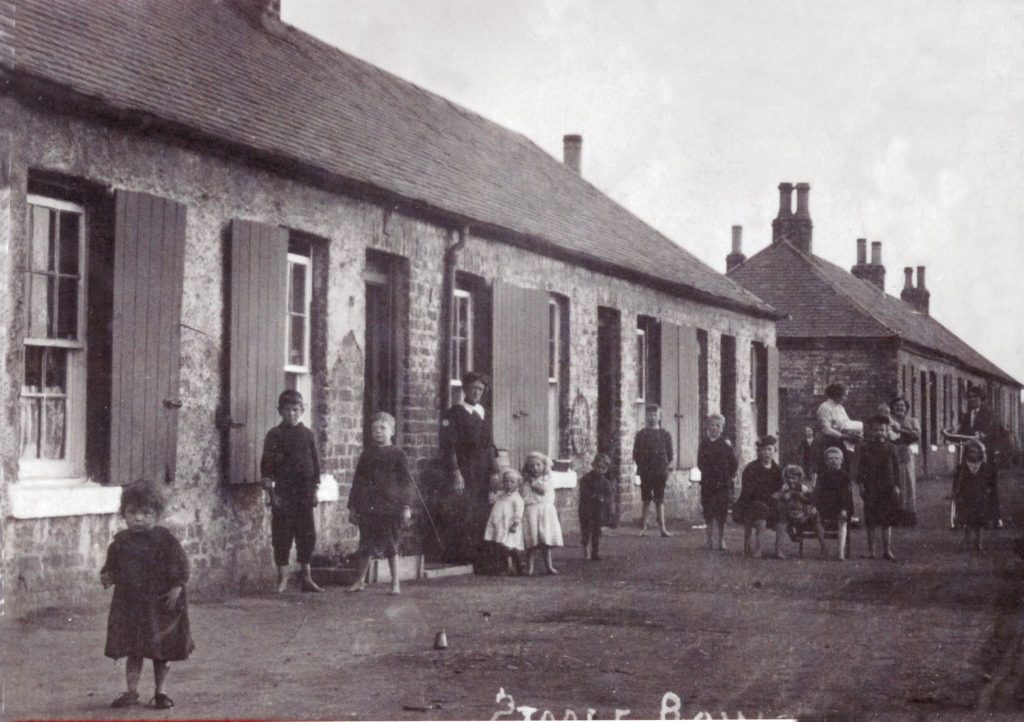
With the mine works and chemical works so close by, the village of Starlaw was said to be constantly a gritty, smoke filled miserable place to live. Although I’m sure the people would have made the most of it and still smiled/ Not that theres much evidence to back that up. However, the photo of the residents of Stable Row shows that they certainly seemed to make the most of it. I guess thats a quality the people of West Lothian have inherited from times gone by is to make the most of whats there and get on with it with a smile.
The Boom Time
When American Chemist James Young discovered the potential in the Black Rock found on the Torbane and Boghead estates, they whole of West Lothian changed its landscape completely. Everywhere and anywhere in west Lothian that they could find it, enterprises were launched to extract Shale or Coal from the Earth. Throughout the ‘Red East’ of West Lothian, Shale mining operations were being carried out everywhere you looked.
These shale mines in turn supplied nearby Chemical and Oil works at Durhamtoun where the famous tincture ‘Paraffin’ was invented as well as the many others like Deans, Boghall, Addiewell, Pumpherston and more sprung up overnight. Of course, this shale need to be transported as did the coal in the ‘Black West’. So a whole Scribble of Railways were laid quickly and the whole of West Lothian became a massive Mineral & Oil works with a thick cloud of smoke from the billowing chimneys was a permanent feature of the county. Works
The Decline
When the Boghall Oil works finally closed down, Starlaw found itself in a state of semi redundancy. Shale was still being mined and shipped out. But its importance and its demand dwindled overnight and work started to become insecure. With less demand for the local area, there was less need for workers and so the village fell into a decline.
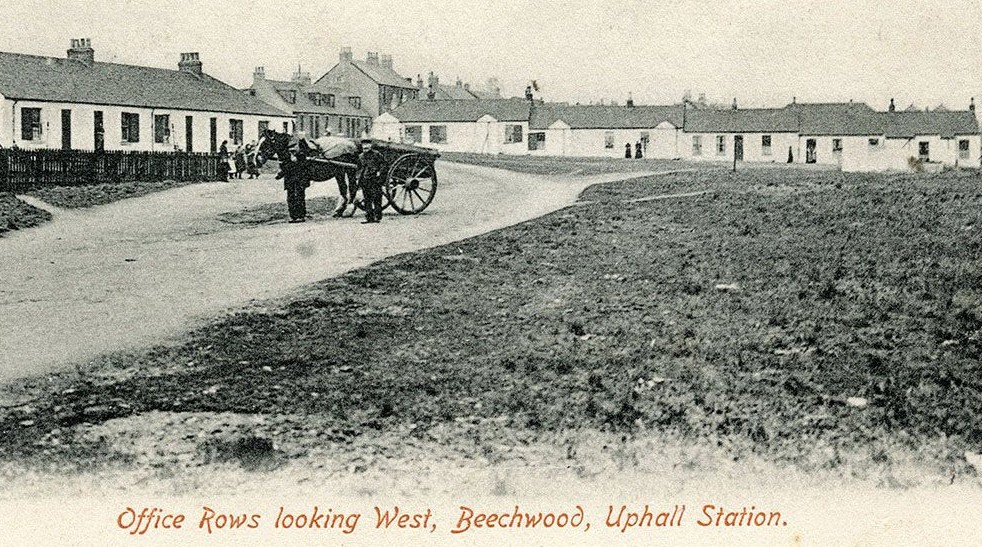
The Pumpherston Oil Company which owned Starlaw at this time, saw a far better use for these workers at the nearby Uphall station works. So, instead of throwing up some more cottages at Uphall Station, many of the houses at Starlaw were dismantled, brick by brick, loaded onto the nearby railroad and shipped over to Uphall Station a couple of miles along the track, where they were successfully rebuilt.
Renaissance
However, this decline of work for the village after Boghall’s closure wasn’t the end of Starlaw. The village experienced a kind of Renaissance period when the Deans Chemical works nearby opened in 1878 brining with it plenty of jobs. This new Second wind for the village gave it a purpose once again. However, it would now serve as operations of Secondary Importance. One of many outlying mining rigs that would serve to supply the Chemical Works. Not the Primary source of Shale that had previously fuelled the neighbouring Boghall Chemical Works previously.
Getting it Fixed
In the 1930’s the West Lothian County Council decided that the people of Starlaw village should have better living conditions. Why should they be forced to live in a single room hell hole when they could live in a Twin Room Hell hole? So, work commenced knocking some of the Internal walls down, turning these single room rows into a row of Kitchen and Bedroom 2 room houses whilst keeping some of the original single room dwellings. The rent for these New Twin Room houses was 2 Shilling 9d, whilst the remaining single room homes were charged just 1 shilling 10d a week.
Tragedy at Starlaw
Now, as you can imagine, with people forced to live in such conditions in such a hurriedly put together enterprise, disaster was never far away. Starlaw itself did indeed experience its own fair share of calamity in its day. Lets have a look.
The Starlaw Pit disaster
On Saturday the 9th of April, 1870, Starlaw suffered a terrible tragedy. Due to the early design of these
This incident that had happened deep under the ground in the nearby Starlaw pit, killed 8 men. Seven of these Eight men killed Starlaw village. That was quite a significant amount of people to die in one day for a community as small as Starlaw was. Every family in the village would have doubtlessly lost at least One member. Quite an impact. At least by todays standards anyway.
But these types of incidents were commonplace back in those days. Both Coal and Shale mining was still a relatively new enterprise. The mine owners were learning as they went when it came to health and safety. At the cost of the lives and anguish of the workers and their families. They were hard times indeed. Throughout West Lothian alone, there has been many Industrial Disasters recorded. Places like Burngrange colliery near West Calder lost a lot of lives due to the experimentation of the day.
Poor Annie
Now, when I mentioned previously that ‘they’ had some of the houses dismantled and rebuilt in Uphall station, i didnt specify who ‘they’ were. In todays Health and safety conscious climate, One would presume that the ‘They’ would mean a team of specialist contactors hired by the Oil company to fulfil this task. Nope. Not in those days. It was left to the residents of the village to shift their own homes, or at least do the donkey work. Worse still, it wasn’t just left to the residents as theyd have been busy down the pit, but to their children.
That’s right! Kids just primary school age were sent to do the laborious task of Redressing the bricks after theyd been dismantled. Chiselling off leftover grout and stacking them onto the train carts that would transport them to their new residence. One of these Kids was a 10 year old little girl called Annie Allen. Annie had been sent to dress some bricks on the demolition site where she sat just a few yards from the walls of a neighbouring house that was also being deconstructed. Tragically, this wall fell down and landed right on top of Annie.
Do you beleive in Ghosts?
The doctors reports say that she ‘died instantly’. But this was at a time where a fatally wounded miner would get an ambulance to take them home to die at the behest of the doctor. So its highly probably that theyd have just said what they figured would sound best to her family.But when the Motorway was being constructed in the Mid 1960’s, some of the workers complained about the sound of a child crying when they were working on this part of the road which would run right through the site of the former village.
Thats not all. Another report came from a road worker in the late 1980s when they were building the new Junction 4a right on the Starlaw village site. He had asked a colleague “Whats that wee lassie daein on this site?” pointing over his shoulder to the area he had just seen a child playing and was concerned about the danger for kids playing on such a construction site. But when his colleague enquired “What wee lassie?” and they both turned around again, there was no one to be seen. Who knows eh?
Abandonment of Starlaw
By the late 1930s and Early 1940’s, most residents of the village of Starlaw had been rehoused in neighbouring towns like Bathgate or relocated to another of the existing mining villages as both the Shale and Coal mining Industry was still very much alive and kicking at this time, albeit with more modernised methods of mining than that of its former days. But by this time, the West Lothian Towns we see today were starting to form, With the smaller villages and rows being swallowed up to make these bigger town and consolidating the areas population.
Village or Township?
When we look at the conditions of Starlaw village and we see the hell its residents had to live in day after day, it leaves a lot to be desired. Some younger people today would never believe it if you told them how these people were living a mere century and a half ago. Someone sparks a cigarette in the School toilets and the whole school is evacuated until the site is deemed safe enough to re enter. Today, we are very stringent on Health and Safety Practices. But this wasn’t always the case.
Back in those days if the building you lived in or worked in caught fire, the main concern was making sure you threw the right water on it. Ie the murky water from the nearby ditch and not the ‘Good drinking water’ that had been carried by hand for miles from a well at the nearby towns of Bathgate or Livingston Station. This was a completely different world back then and what we see as inhumane conditions today was nothing out of the ordinary to the residents of places like Starlaw and many other Lost Villages of this sort around west Lothian.
By todays standards, when we look at some of the squalid camps that people were forced to live n places like South Africa, we see a closer resemblance than that of a modern West Lothian village. So, it begs the question – we these Old residencies of the Industrial revolution in West Lothians really ‘Villages’, or Townships?
Starlaw Today
Sadly there’s nothing left of this old village and its site is now partly occupied by the M8 motorway. The other part is now the roundabout for the Motorway Junction. In fact, if you drive out from Edinburgh on the motorway and turn off at junction 4a (Livingston West), you’d have already passed right through the site of the village. With so much repurposing of the land and the subsequent landscaping involved, there is very little left to indicate this village even existed.
However, the nearby Starlaw Industrial Estate near the old Pit site, which now homes the Distillery, is aptly named in Tribute to the place. On the Site of the Old Shale mines offices, stands Starlaw house. Partly built with remnants of the old buildings stands Tribute to this Once bustling village. Besides these and the odd artefact a keen metal detectorist or Mud lark digs up, the only evidence of the towns existence lies in the records, maps and history books. This is why it’s so important to keep this history in remembrance.