Blackburn is a small town in the area of West Lothian knpown as the “Black West” due to its vast coal fields.
The History of Blackburn
Blackburn is a village that was born from the Industrial boom. So unlike many conventional towns that would start small and gradually grow over the centuries, Blackburn was different. It originated more as a collection of Five small settlements. This type of formation of a town is not uncommon in West Lothian with places like the nearby town of Fauldhouse forming in a similar way. These Five Villages or settlements were
Early Origins
The earliest known recording of Blackburn was in 1152 . When the great Glasgow to Edinburgh Turnpike was opened in 1764, the village would serve as a staging point with Lodging houses and Inns such as Redhouse. This farmstead which still lies derelict on the far east end of the Towns main street. This was built around this time to facilitate the stagecoach travellers on the Turnpike.
A Weaving Village
Throughout the Eighteenth century, Blackburn had a steady little trade going with Weaving. On the west side of the village we can still see existing cottages that were once weavers cottages. These buildings would have doubtlessly been the homesteads of the weavers but were also their workplace. The buildings would have used their full length to splay out long weaving racks that would produce clothing and linen and created a steady economy for the weaving residents of Blackburn.
In 1793, the Hopefield Mill on the West End of Blackburn Main street was built. This is where they would weave cotton that was being Imported from the colonial plantations in the Americas. It was here that this cotton would have been woven into clothing and linen. This thriving Industry made this village a busy little village that was growing fast with the industrialisation.
The mill was powered by water wheels turned by the water that ran along the man made channel that was dug for this purpose, channeling water for Half a mile from the River Almond.
A Mining Town
In the Early to Mid Nineteenth century, West Lothian would see the arrival of the Coal mining Boom. All over the area, especially on the ‘Black West’ side, collieries sprang up everywhere. Some only a couple of hundred yards away from their neighbouring pits. Most of the Towns of this area were either born from or benefited from this coal mining boom and this village was No exception.
Blackburn’s Historic Buildings
Although what makes up the majority of Blackburn today is fairly Modern, there is still a significant part of the Town that predates the Twentieth century and has quite a few Interesting buildings of Historical Interest. So, I’ve decided to list a few here for you to explore.
Blackburn House
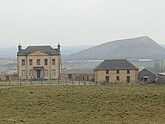
If you approach the village of Blackburn from the East side coming from Seafield, on the left hand side of the road, down the long slope towards the River Almond, proudly stands Blackburn House. This house was built by George Moncrieff in 1797. Moncrieff had been an entrepreneur with Sugar Plantations in Antigua. He used part of his fortune made in these plantations to build this Big Georgian Manor Home.
A Grand Big House it was too. Even Today, the Stately structure of this Big house still has a commanding presence. It stands boldly in the Almond valley and can be seen from afar.
Red House Steadings
If you are approaching the village on that same road from the East, you will see an old farm steadings on your right hand side. These steadings were established around 1777 when the Great Glasgow to Edinburgh Turnpike road was opened. It was built as a lodging house for weary Stagecoach travellers to stop over for the night.
The Expansion of Blackburn
The village really saw a boom in development again in the 1960s when the City of Glasgow burst its banks and experienced an Overspill due to over crowding. Many of these families who left the city moved out to West Lothian where the Newtown of Livingston just a few miles East was purpose built to house many of these families. However, the wave of immigration was much bigger than what Livingston itself could hold and most of the villages of West Lothian, Especially in the Black West would expand due to this influx of people coming to stay there to get away from the cramped slumlands of the city.
One of the biggest attractions that brought these Overspilites to the area was the opening of the British Motoring Company’s plant at Wester Inch near Bathgate on the road to Blackburn. Many men came from Glasgow to work here and would settle with their families in Towns and villages around the area. Blackburn played its own part in housing these workers and the whole North East part of Blackburn was constructed to provide council housing for these workers. This development more than doubled Blackburn in size.
Modern Blackburn
Today, Blackburn acts as a commuter town much like its surrounding towns and villages. Once a place where its residents lived and worked, Blackburn is now a place where residents leave the village to work and come back hoe at night to stay. With the nearby Train station at Bathgate giving access to both Glasgow and Edinburgh, this has made commuting much easier and accessible.
The Village which is surrounded by Historic sites and woodland regeneration programmes. This in recent years has led to the formation of community groups to establish and maintain community woodlands and walks as well as Historical Organisations that take great pride in their village’s heritage and colourful History.