
Mid Calder is a Prestigious Old Town to the Eastern Side of West Lothian in what is known as the Prosperous Red area of West Lothian, aptly named due to the large amounts of Shale bings that shine a bright red in colour. But the town of Mid Calder is far older than the mines around it. Lets have a look
The History of Mid Calder
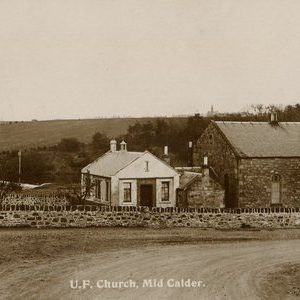
The Name of Calder comes from an old P Celtic word which translates ‘Woodland by the Water
Early Origins
The barony of Calder was granted to Sir James Sandilands in 1348 as a Wedding Dowry when William Douglas, First Earl of Douglas when James married his sister, Eleanor Douglas. This barony included the Barony’s seat itself, Calder House and the surrounding lands between the Almond River and the Murieston water. Situated in the Middle of the country on the crossroads of the main East to West road and the North – South drovers road. the area was a busy place.
But in the turbulent times of the Middle ages, it was also a dangerous place to be. So Calder house was constructed as a castle hold with walls that are 8 feet thick.
Lord Torphichen
If you pass through the Mid Calder on the Main Street, at the Top of the Town, you will see a Pub called ‘The Torphichen Arms’ which may catch your eye. As the village of Torphichen lies a few miles away to the North West, you probably wonder why a place named such is here in Mid Calder. This was due to the Baronet James Sandilands being bestowed title ‘Duke of Torphichen’ in 1564 by Mary Queen of Scots .
The Reformation
The Witch Hunt
In the 17th century, all over the British Isles, War was rife and a powerful weapon of war has always been propaganda. The propaganda of this time was the accusation and execution of ‘Witches. In 1643, Mid Calder experienced what became famously known as ‘the Calder Witch Hunt’. When new Clergyman, James Kennedy, only 22 years old and bloodthirsty man desperate to use his power to execute’ Gods Judgement’ came to Mid Calder.
Five women including Agnes Bishop, Marian Ramsay and Janet Bruce were accused and executed for Witchcraft. . They would torture
A case 80 yerars later of the bewitched Child occurred in 1733. The Sandilands were said to have called for an exorcist from Edinburgh to come out and expel the demons from a family child they beleived to be Possesed by evil spirits.
A Drovers Town
In its peak year as a drove town in 1840, it was said that over 150,00 cattle were driven through the village of Mi Calder to cross the River almond at the Brig.
The Age of Steam
In 1848, the Great age of Steam came to West Lothian. However, the initial line proposed to pass through the village of Mid Calder. But this was not pleasant words to the ear of Lord Torphichen. So, he had the railroad rerouted to the nearby village of Kirknewton where the station was named Mid Calder and stayed that way until recently.
Neither the Stagecoach nor the Drover could keep up with the speed of Transportation that the Train brought. So both the trades from the North to South Drove road and also that of the East to West Turnpike completely dried up and Mid Calder was left vacant. Before long, the thriving Trade and commerce of Mid Calder was decimated all because a Stubborn aristocrat refused to accept the modern age in his back yard.
The Age of Shale
But fortunately, the fate of Mid Calder was saved by a Twist in the History of West Lothian. Which Twist was this then? It was the discovery of Shale in the area and its derivative, Paraffin which became the new popular fuel for Lamps. Once again, Mid Calder would soon become a busy little town again being surrounded by Shale mining operations.On average, 3 million tons of Shale were extracted from each mine
Mid Calder Today
Today, Mid Calder is a commuter village which serves the nearby City of Edinburgh and the Neighbouring New Town of Livingston. It is a Conservation town and recently received a £25,00 grant to establish a new heritage trail.
Mid Calder’s Historic Buildings
Today, Mid Calder has 22 listed buildings of historic interest
Calder House
Calder House was Initially built in the 13th century as a castle keep, or fortress. With walls of 8 foot in Thickness, this stronghold was quite impregnable. However, as time moved on into the renaissance period, the castle was given a new faced and was built over so that the castle looked more like a 16th century manor house. With its Grand door entrance and its lush big windows, Calder House became a massive Manor home.
The Kirk of Calder
The People of Mid Calder
Future Development
1564: Sir James Sandilands is created the 1st Lord Torphichen.
1606: Act of Parliament “thirls” miners and colliers to the land as serfs.
1644: The height of the local witch hunts under Minister Huw Kennedy.
1775/1799: Acts of Parliament finally abolish mining serfdom in Scotland.
1806: Construction of the “Dry Brig” landmark (demolished 1959).
1848: Frédéric Chopin visits; the railway is diverted three miles from the village.
1870: Shale mining reaches a peak of 3 million tons annually.
1962: Shale mining finally ceases in the Mid Calder area.