The West Lothian Town of Whitburn is Situated in the Black West at the far Western end of the Shire and is the epicentre of Black West Lothian. First appearing on record far back as 1363. Whitburn has evolved over the centuries. From a humble hamlet of weavers cottages, through the changes of the Industrial revolution to the present day commuter town that it is.
The History of Whitburn
Whitburn is One of those little towns who’s original centre has stood in the same place for centuries and has gradually grown up around the crossroads which would become a central point in the Glasgow to Edinburgh Turnpike road where it crosses the North-South road from Falkirk to Lanark.
It has evolved in multiple layers as the town has progressively grown over the centuries, adapting to the times. From tiny roadside hamlet growing into a thriving little Weaving town. Through the Industrial revolution to become a Mining Town and later a Factory town until its decline in the 1980s and 90s. It went on to become the commuter Town that it is Today.
Originally, the waterways worked as the border markers. Whatever lay between the River Almond to the North and the nearby White burn, from which, the town derived her name, to the south was considered the Terrain of the Town. So the Town was aptly Named ‘Whitburn’. But obviously, over the years of development, these boundary markers have changed and Whitburn is much bigger now.
Early Origins
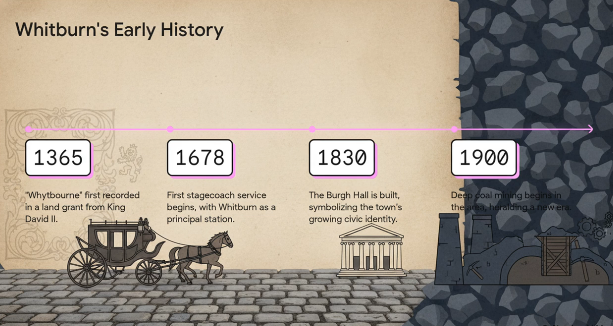
Whitburn is First recorded in 1363 as Whytebourne when, according to a Royal document dated September the 26th of that year, documents Whitburn as a busy popular stop on the Glasgowo Edinburgh trunk road. Two years later in 1365, a land grant was awarded by King David II to establish a Pit stop Inn for travellers on the great cross country road. . At this time, Whitburn only really consisted of a few buildings of a small settlement on the main road between Glasgow and Edinburgh. But by 1978, Whitburn had become a well established Coach Stop with its numerous Coach yards and it’s Tavern on the Crossroads. This served to cater for not only the east to West travellers of the Cross country road, but also those who travelled the North South road to Lanark and beyond.
Being in the centre of the country, both these roads would have been a busy thoroughfare. So Whitburn was certainly a busy little Stop-over town. This period of Whitburn’s history is demonstrated in the Towns coat of Arms where can see a stage coach prominently shown beside a sheath of wheat, highlighting the Towns agricultural heritage.
The Barony
In 1465, Landowner George de Crichton was knighted Baronet of Whitburn.
A Weaving Village
In the centuries leading up to the early 19th century, Whitburn steadily grew from being what was once pretty much just a few steadings and Travellers rest on the Main cross country route between Edinburgh and Glasgow, into a thriving little Weaving Town. in the easy 15th century, the village had a small cosy population of only about 500 people. But, By 1796, Whitburn had grown to a vibrant little population of around 1300 people . It had its own prestigious Church and Ecclesiastical college up the hill on the South side of the town.
Of course, back in these times, Towns like these weren’t so centralized as they are now. So you’d have had many nearby residences of perhaps only Two or Three homes. Many of these steadings which lay sufficiently far away from the village are still in existence today as working farms. But many of the closer establishments were subsequently swallowed up as the town expanded and would have been incorporated into its growth.
The houses of Whitburn at this time would have been made from Wattle and Daub. Small residences, almost mud huts with turf roofs would have lined the main street. Inside, these were very primitive places of survival for people and livestock alike who were often known to live under the same roof. These buildings have all gone now, with the last remnants of anything that came close to these settlements having been situated on the Bog Road where the One time Weavers Rows are now a hedgerow between the George V park and the Murraysgate Industrial Estate.
A Mining Town
By the Easy 19th century, Land owners and farmers around the Whitburn and broader central belt had started discovering minerals that lay beneath their fields and meadows. Initially, many of these Early mines would have been mining Iron Ore. It was an age where people gave far less thought to the environmental impact and more about either profit or survival, depending on whether you were the miner or the owner of these workings.
Black |Gold
To the Immediate North of the town on the other side of the Almond river lay the vast Torbane estate of huge geological significance. Here on this watershed area between the Black West Lothian and the Red , lay a very rare mineral that couldn’t e found anywhere else in the world. A mineral that was almost a mix between Coal and shale with a very Oily consistency that made it perfect for distilling. It was Torbanite, often called ‘Black Gold’ and neighbouring Boghead coal that they derived the Original Paraffin from at the nearby Durhamtoun Chemical works.
To the South of the town, the Industrial revolution and the discovery of coal seams brought a turbulent change to the landscape with coal mines dotted all over the area. Areas which once were vibrant with Small Riggs like the Polkemmet moor eventually became swallowed up by Polkemmet as modern mining methods were introduced. But to the east, remnants of the early coal mining age st/ill lie in place amongst the agriculture and ;later forestry of the land. Old mine workings on the Torbane Estate though were still clearly visible in the late 1980s and the now waterlogged area still holds so much buried remnants of these days.
The Dardanelles
Polkemmet Colliery was a modern Colliery. An Industrial experiment using modern deep shaft methods and its First Shaft was initially sunk in 1313. Just on the eve of WWI which subsequently led to the pit becoming quite a challenge to get open. But this was hampered by flooding after letting in almost 60K Gallons of water per hour when the miners hit an underground water vein. But after a determined effort to clear the water in 1917 for digging to resume, by 1921, the pit was pulling out coal. This new pit was taking out around 2000 Tons of Coal each day and employed over 1500 men.
The pit was aptly named ‘The Dardanelles’ due to the battle involved in sinking it being compared to the WWI military Campaign at the Dardanelles Straits which had been going on at the same time.
Factory Town
In 1969, The Levi Strauss Denim manufacturers opened up their factory in Whitburn. For many years, this was the UKs only branch and the companies largest branch outside of the United States. It manufactured and sold over 4 million pairs of jeans annually and employed between 500-600 local people. Most of the workers were women who lived locally in Whitburn. The plant closed its door in 1999 and many local jobs were lost as well as their being a chunk of the Town missing too.
A Modern Town
Today, Whitburn has become a commuter town with a great chunk of the Towns population travelling daily into the nearby Cities of either Glasgow or Edinburgh for work. Industry in the town itself these days is very much service based. With the completion of the nearby Almondvale Shopping Centre in Livingston, most of what Once was a bustling Main street full of shops, like so many other nearby Towns, has been swallowed up. The Main Street Whitburn today has become a Kinda Leisure Plaza. Lined with Cafe’s, Takeaways, Hairdressers & Beauty Salons alongside Convenience stores, Estate agents and of course, no shortage of Betting shops, the Main street has also become very much service based.
With the fairly recent addition of the Train Station just a mile up the hill at Armadale and the Heartlands Motorway Junction at the West End of the town, Its never been easier to get in and out of either city.
Whitburn’s Historic Buildings
It has to be said that in comparison to some of West Lothians more prestigious towns, Whitburn’s preservation of its Old historical buildings hasn’t been the greatest and many lovely old buildings have been knocked down over the years to make way for newer, less attractive buildings. This is perhaps due to a more humble population through a recent age where survival was more a priority than preservation of History.
So, sadly Whitburn has lost a lot of lovely old buildings over the years to ‘Progress’. But there are still some Grand old buildings left today, as well as buildings perhaps not so grand in stature, but Rich in History. Sadly, others like the Great Torbanehill House that lay on the North eastern edge of Whitburn which was razed to the ground i the late 19th century, no longer exist. But we can still see their presence on old maps and sometimes old photographs and if were really lucky, on video. But any old settlements from the Town’s Earlier times only exist now on paper and in Lore.
The Expansion of the Town
It has been claimed by many Locals that in the Old days, the waterways worked as the border markers. Whatever lay between the River Almond and the White burn, is what can be considered as Whitburn. Still still hold to tat view today. But as far as the Towns development is concerned, the banks of the Whitburn have long since been breached. The Croftmalloch Housing Estates, a series of Housing projects built-in the 1970’s all lie South of the White burn. As do the later development of ‘The Glens’ Estate to the South East of the Town.
But way back when these water boundaries were set out as part of the Polkemmet Estate owned by the Baillie family, Whitburn was much smaller.
Whitburn’s latest development, The Heartlands project covered over 600 Hectares and was Europe’s most daring feat of architecture in modern times.
The Concrete Curtain
In 1966, the M8 Motorway designed to join both cities of Glasgow and Edinburgh was opened. This would run parallel to the Old A8 Turnpike road, crossing its track at the bottom North side of Whitburn. This acted like a kinda Concrete Curtain separating the Town from the River Almond just on its edge. It had its own ‘Checkpoint Charlie’ if you will, where we now must pass under a flyover to enter the town from the North.
The People of Whitburn
Much like the UK itself, Whitburn is a town of Mongrels. It has experienced the Influx of many different peoples over the centuries of its existence. Especially over the past century and a half since the Industrial Boom. Its hard to tell where a lot of the weavers of the times before the 18th century came from but its highly likely that these people had lived here for generations as some of the surnames mentioned in the old records of that time are very ,much still prominent names in the town today.
However, with the soar of employment in the area that came with the discovery of the Iron and Coal mining, Men with their families came from all over Scotland, Ireland and Indeed all over Europe seeking Employment and as a mining Town, Whitburn soared from a quaint little population of 500 to a booming 12,000 inhabitants. These were all the people who came to Whitburn to work the pits, stayed and helped forge the town into the boomtown it became and is today.
Coming Together
As the Industrial revolution swept across west Lothian, the areas around Whitburn became peppered with collieries. many of these would have been Short lived enterprises of Shallow mining that would last a few months to a couple of years, then abandoned for new land to mine nearby. This intense minin around the Black west brought with it a lot of Migrant workers from all over Europe. Small mining Towns would hav ebeen hurriedly slung up as residences for these miners and their families. Villages sulike East Benhar high on the Polkemmet Moor, a Once thriving community now almo0st compoletely vanished.
West Lothian had over 20 of these villages that no longer exist. Ghost towns of an age gone by. An age that forged Whitburn and Indeed West Lothian into what it is today. As these villages declined and eventually vanished, its residents were rehoused in nearby Towns which were building New Luxurious homes for these miners. These homes which were very luxurious for their time . Their prototype, like those on Jubilee Road in Whitburn can be seen all over west lothian, built around the 1930’s. and remain some of the oldest houses in the town.
Refugees from the East
In 1939, Germany’s Leader and Dictator Adolf Hitler alongside Russia Invaded the Country of Poland. The Polish army were forced to flee the country and came to Britain where they would remain stationed as an active unit for the duration of the war. Some wealthy ;land owners who were able to facilitate, offered hospitality to the Polish Army and let them se up barracks on their estates.
One such Estate was the nearby Polkemmet Estate whose seat lies to the West of Whitburn and who’s lands include the Town itself.. The Land Owners, Lord and Lady Baillie allowed the Polish Army to establish a Barracks in their Estate garden. This garden, now known as Polkemmet Country Park still holds remnants of this Once busy community of Polish soldiers and their families.
Once the war was over, many of the Polish Troops returned thome. But many who for reasons of their own couldnt go home or had no home left to go back to. It had afterall been a bloody war which was a huge purge on Europe, especially Poland. Many of these people and their families stayed. For a short time after the War, these barracks remained a thriving community.
However, Once it was clear who was returning to Poland and who was staying, the Inhabitants were gradually moved out of this almost Prefab throw up estate to Proper houses in some in Whitburn where they could carry on working iin the pits. The village of Greenrigg to the other side of the barracks also housed some of these families who had found work in the nearby Greenrig and Southrigg Collieries.
Refugees from The west
But they certainly weren’t the last Influx of population to Whitburn. In the 1950s and 60’s, the Glasgow Corporation demolished vast areas of slum housing with highly condensed population. They rehoused the tenants in new homes built freshly for them in the City’s New Estates like Easterhouse, Drumchapel & Castle milk amongst many more. But it wasn’t long before the demand was still high for sufficient housing. With this new taste for freedom and the Good Life, many Glasgow families moved out of the city for a better, cleaner and healthier life in the countryside where they were offered safe jobs.
This wave of Migrant Glaswegians famously known as ‘The Overspill’ are commonly understood to have moved out to the numerous ‘New Towns’ that were built for the purpose like Irvine, Livingston, Cumbernauld, east Kilbride whilst some of the more Foot-Loose migrants ventured as far as Corby to work in the Steelworks there. But although West Lothian housed her fair share of Overspillites in Livingston, Whitburn too did her bit.
Many Families moved out from Glasgow in the Early 1960’s when the British Motoring Company (B.M.C) plant in Bathgate opened up and settled in Whitburn. They were housed in purpose built houses to the Immediate West of Murraysgate, where Whitburn ended at that time. Thus expanding the town and its population some more.
There was often said to be an air of contention between the Whitburn Locals and the ‘newcomers’ as they were known. The parents had trouble trying to get their Children Enrolled at the nearby Polkemmet Primary School because they were ‘Outsiders’. But with a tough campaign by some of the parents, the kids were eventually allowed to attend the school.
Music and Events in Whitburn
Each year, Whitburn holds it’s annual Gala Day on the 4th weekend of June. The ‘Civic week’ on the week leading up to it is packed with events each evening. It boasts a variety of activities like Sports tournaments, Live Entertainment, the Street fair and even a Fun Run and Fun Pram Race. These all lead up to the Grand Finale on the Saturday which is the Gala Day itself.
The event procession includes a parade of Marching bands, Kids walking in Themed Fancy Dress with decorated Truck trailers known as ‘Floats’ between them. The parade ushers the Star of the Day, the Gala Day Queen to the King George V recreation ground on the North Edge of the town. It is here with full pageantry, the Queen is Crowned and a host of festivities, shows and games proceed for the afternoon. There is also a Fairground in the park whose arrival many locals keenly await with excitement year after year.
Whitburn also boasts its collection of Marching Bands including Three Flute Bands, a Champion Pipe Band and the Multiple Award Winning Brass Band. A reminder of days gone by where miners would play Brass instruments to keep their breathing healthy. The Town also has its own share of Famous Music Celebrities such as Lewis Capaldi, Leon Jackson
Future Development
Like so many other towns around west Lothian, and indeed Scotland, we are seeing a building boom at play. New build houses are going up all over the place and the Heartlands housing Estate is still yet to expand. With the recent opening of the M8 Motorway Junction Number 5 at Heartlands, we are seeing the retail and business park starting to spring up. So, who knows what development and growth the next decade or Two will bring. But Whitburn is certainly a Town thats on the map now.
But unlike those sorry decades of the past which were a kinda ‘Dark Ages’ for History Preservation, Whitburn and Indeed West Lothian in a broader sense has adopted a far more positive approach towards History and Heritage of our area. With the assistance ocf Todays technolical wonder, the worldwide web, people are much more able to extend further research into their local history whilst connecting with likeminded individuals.
A Strong Community
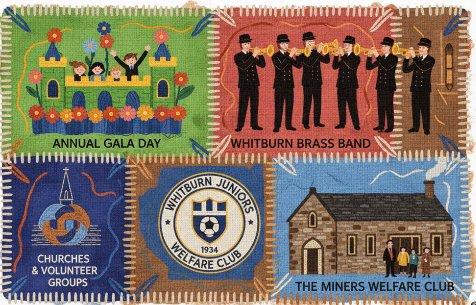
Despite all that has been thrown at it over the decades and centuries of the Town’s existence, Whitburn has always displayed a strong community. Strong community bonds and endeavours such as the Brass Band, Miners Welfare, the Football club and Annual Gala Day alongside Church and community groups, the strong social fabric of Whitburn is a durable One.