On the far North West corner of west Lothian, you will find the village of Westfield. A tiny unassuming looking settlement. Westfield looks like the sort of place where nothing exiting has ever happened. Like somewhere that has always just been a tiny little dot on the map.
But looks can be deceiving. Although the village of Westfield today is just a small village of around 180 new houses, this is actually a different village from the original Westfield. The old village died just a few generations ago. This place was much bigger. It was also much more livelier than its namesake that lies nearby today. The original village was once a bustling hub of Industry.
Westfield – The Vanished Village
Not so long ago, Westfield was a busy little Industrial town with over 43 houses, a school and a whole community of hundreds of people. So, how does somewhere so established, end up the tiny little place it is today? So, how does all that industry just vanish? Well, to find that out, we Fist need to take a trip back in time and take a look at the towns history.
To understand why the bustling Industrial Hub of Westfield just seemed to vanish, we need to go right back to the beginning to understand why the village was even there to begin with. You see, Westfield wasn’t a conventional organic village that gradually grew over the years and centuries. Instead, it was built for a specific reason. The story of Westfield is really a reflection of the Industrial revolution in Scotland.
To see how the village plans to navigate the 21st century, we have to look at how it’s foundations were engineered in the Nineteenth. The area around here really began to take off in the 1840s with the construction of the Gowan bank estate. Walter Gowan and his son, the Architect Sir James Gowan designed a complex of buildings that were highly unusual for the Scottish Countryside. Today, their Ornate Stonework is protected by a Category A listing.
But around this time when the Gowan’s were creating their architectural statement, a much rougher working class reality was taking shape nearby, down on the banks of the River Avon. The village began to grow as a hybrid of Two different worlds. Victorian Architectural ambition came directly alongside raw Industrial labour.
Forged by Industry: the Rise of a Village
Westfield wasn’t Born. It was Built. Forged by by the coal and Industry of Nineteenth Century Scotland. The settlements whole reason for being were tied to the rich seams of coal that run underground below it as well as the valuable stone that could be extracted from the nearby Quarries. The Westfield Brickworks were built around 1841 and the village quickly grew up around these industries.
The houses of the Old original village were constructed to house the workers and their families who had come from all over seeking employment. But the towns biggest employer was the paper Mill. When it opened its doors in 1854, it quickly became the source of employment for a few hundred people and the majority of Westfields population.So Westfield was a village that was built for the workers of these Industries who fuelled that Industrial Boom.
Boom Town
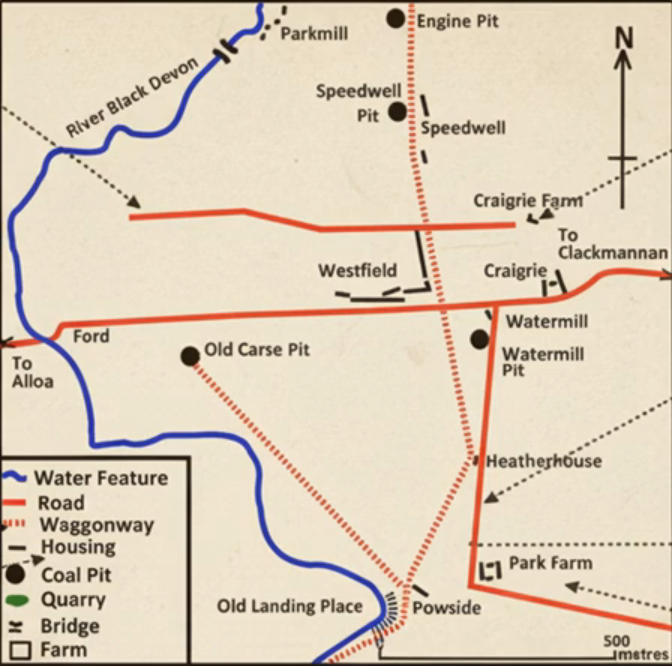
The village hit its height around the 1840s when workers and their families were pouring in. People came from all around the place to work i this busy new Industrial hive. This old map from 1848 on the right here, shows how the village is nested right in the centre of all like the spider amongst a web of this Industrial activity that forged it. You can see the Brickworks and Coal mines with its roads and horse drawn railway that was used to move all this production around.
Westfield Paper Mill
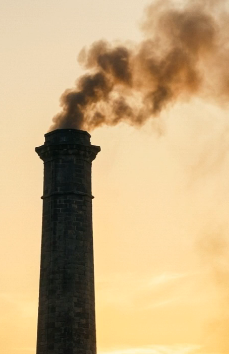
The Westfield paper Mill was established in 1854 by the Westfield Paper Company, Inveresk. It would become the corner stone for the village and It’s biggest employer. In the 1960s, a giant turbine was installed in the mill, This would go on to power the entire village right up til the mills closure. Without that Mill, for a lot of people, there would be no Westfield. In many ways, the Westfield paper Mill served both as the beacon that shone bright to keep the village on the map and the powerhouse that ran it.
When the Mill finally closed its doors in 2002, the village ceased to be an Industrial town and became entirely a residential village. But the 180 residences of the new village lost not only their main source of Employment. They also lost their social centre too. The paper mill was the hub that dictated the rhythm of the villages social structure for generations. It would not have been unusual to see a School dance or a village dance to be held on the shop floor of the Mill. This was a regular occurrence here throughout the latter half of the Twentieth century.
An assessment by the Scottish Working Peoples History Trust (S.W.P.H.T.) notes that “Westfield offers a rare look into how a single work place can define the entire social structure of a community”. Their conclusion was stark. “Without the mill, Westfield as we know it, would not exist”. This makes a very good point. I always remember the Village of Westfield towards the end of the Twentieth century being most famously known for its paper mill. In fact, besides some houses, I dont recall there being anything else of significantce being of highhlight there at that time.
The People of Westfield
So, with all this Hustle and Bustle of the Industrial revolution going on here right on it’s doorstep, what was it like to actually live in Westfield during the Nineteenth Century? Well, the records show that the village peaked its population in 1841 with over 200 people living there. But after that, even with a little recovery here and then, the population would see a long and slow decline. Eventually, the village would empty out altogether.
Living conditions in Westfield were pretty hard going. Reports from 1875 Local newspaper article explains how, inside these houses there was cramped conditions with the places being damp and stuffy with floors made of coal. What a fire hazard to say the least. It reports how an old piece of dirty sack cloth lay on the floor by the fire and was quite Black with damp. It goes on to note how, in One of these residences, Ten people were crammed into just One room and a kitchen apartment. Imagine how tough it must have been to live in these places back in those days.
But it wasn’t just the living conditions at home that were bad. Working Life was a daily struggle to avoid danger. The work in the industries that surrounded Westfield was very dangerous. In 1876, tragedy struck when a 17 year old young man named Francis Love was killed in the coal mine. He had been working down the pit when a stone weighing over a Ton fell on his head, crushing him to death. this was the constant and tragic realities of many of the residents of the village.
The Great Decline
Faced with these harsh conditions, many families saw only One chance of escaping this hell. That was by emigrating to other countries within the British commonwealth. Many families would subsequently emigrate from Westfield to Australia, Canada, New Zealand and America amongst other places. But cramped conditions and dangerous working environments were commonplace wherever you went at this time. So, besides these, what was it that made everyone want to move away?
Well, in reality, it wasn’t just One thing, it was a mixture of different issues that brought about the demise of Westfield. more like death by a Thousand Cuts. As the Industrial revolution soared on with the twentieth century approaching, the coal seams which were easy to reach became all worked out. Bigger and more modern mines started opening up in other places which led a lot of the workers away. But another crucial factor was that whilst most of the nearby towns like Armadale, Bathgate and Linlithgow all got water piped in, Westfield didnt. This in itself made the village a much less attractive place to live.
1898
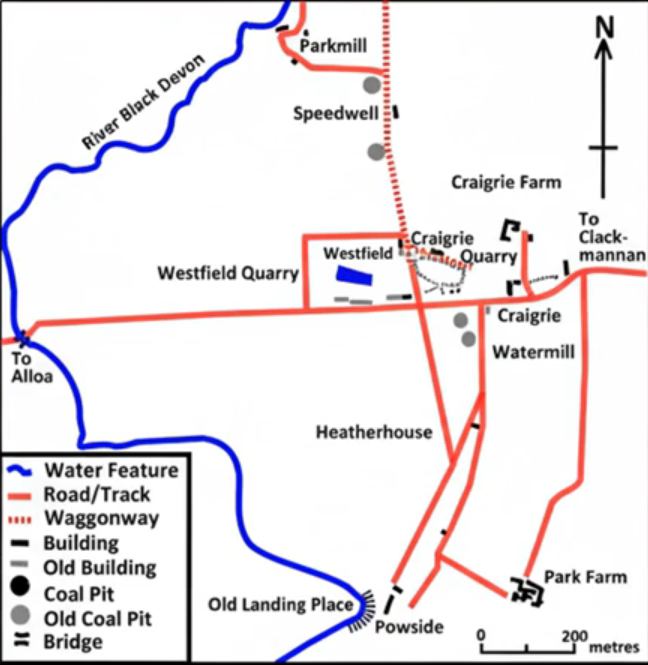
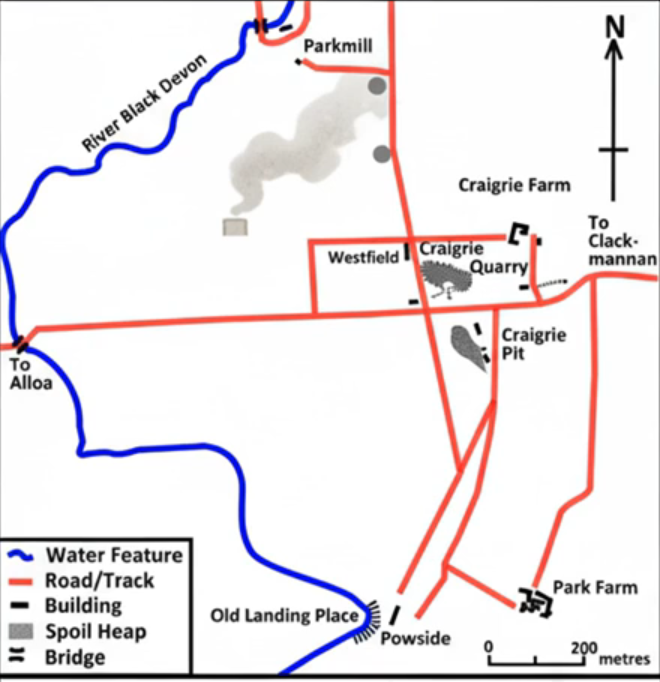
In a map of the village and its surrounding area from 1898, you can see the Village still there. It is still very much a recognised place with all of its houses still present on the map. But, if you look closely, you can see how some of the nearby pits were already marked as abandoned. You can see that the decline had definitely already long started by this point.
We can also see from this map that the Old Care Pit seems to have long since vanished by this point. So too with it, the old horse drawn rail road that ran from the Old Landing place at Powside. Although, notice how the old track that had previously led back towards the village has by this time been upgraded. It has been replaced by a road. The steam age would have doubtlessly changed the surrounding landscapes dramatically over the latter part of the nineteenth century. So too the methods of haulage and type of wagonways used.
1945
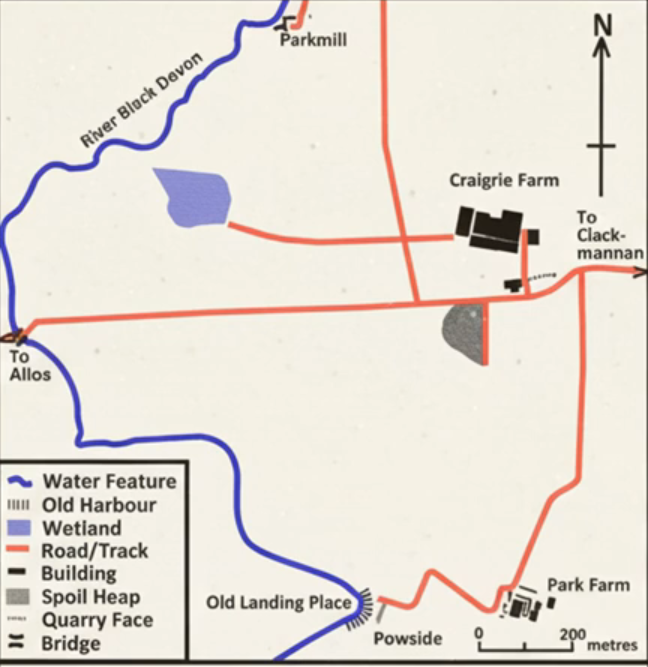
Now, if we jump forward almost fifty years to 1945, the changes that we see in the village are quite dramatic. The quarries and mines have all been abandoned.
We can see here that almost all of the houses that once stood here are gone. In fact, only Two small buildings stand here on the site where the village once proudly stood. You can clearly see that by this time, the landscape has just emptied out.
2004
Now, let’s fast forward another Sixty Odd years to 2004. Just Two years after the villages last remains of its Industrial past , the paper Mill, closed its doors. the process is complete. The village is completely gone and totally erased from the landscape.
Here we can see that the very last traces of the original old village have long since been demolished and swept away. On the site where those 43 houses once stood, is now just an open field.
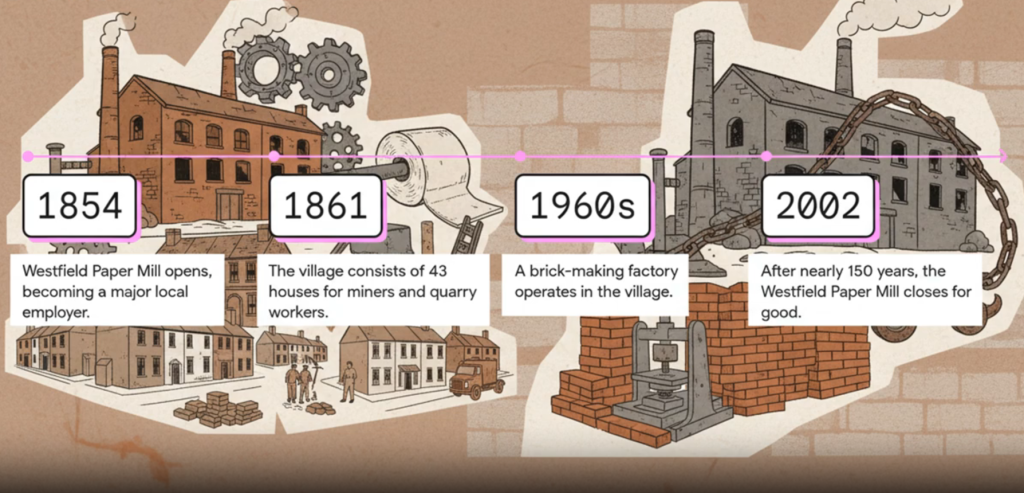
So, that right there is the answer to our question at the very beginning. We can see that the same force of industrialisation that created the old Westfield village turned out to be exactly that same force that extinguished it in the end.
Echoes in the Landscape: What Remains Today?
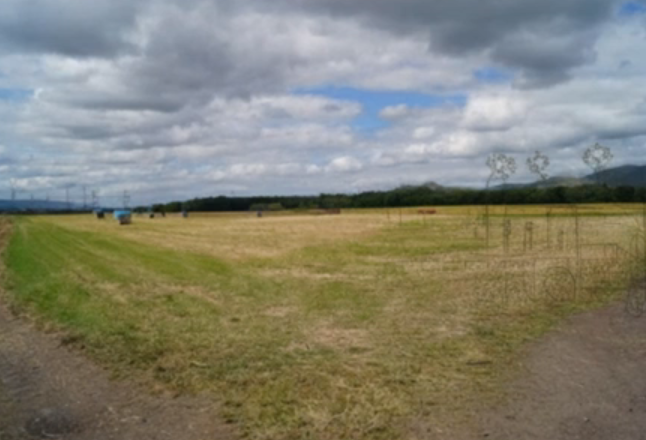
The Old original village of Westfield came to a complete end around the 1960s although the paper mill survived until much later. But all the houses were gone. But, this wasn’t the end for Westfield. Although the old original houses are gone, the village of Westfield still exists today. Newer houses just a few hundred yards away from the site of the original houses . These are the homes that form the modern day village of Westfield. The name lives on and there are still echoes of its industrial past that we can find in the earth around there today.
The newer houses built up throughout the twentieth century whilst the old, original houses declined. The site where the old original houses actually stood is completely empty today. All thats there is an empty field. So we can see that through its own story, The village of Westfield still exists today, but h seems to have moved a few hundred yards over the way.
The new village has more of a Suburban feel and is entirely a commuter village. Where the Old village was a workers village where people lived, worked at slept, the new village is not. Instead, people live and sleep there but usually go to work in other places. Many commute into the nearby cities of Glasgow or Edinburgh to work office Jobs. However, with more people working online remotely from their homes, could be a new era for our villages today?
The Fight for Gowan bank
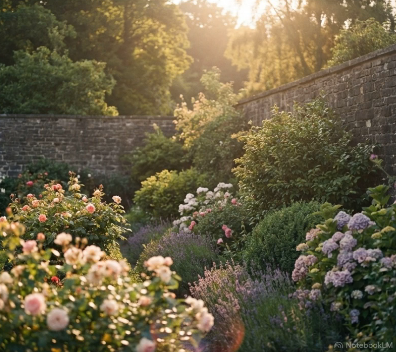
The estate home and gardens of the Gowan bank estate were first built around the 1840s. Walter Gowan and his son James who was a famous Scottish Architect, decided to build Gowan bank. This was meant to be as a display of their architectural talent. They created a whole complex of uniquely ornate buildings with elaborate quaint architecture rarely seen in Scotland at this time.
It was a very exotic looking establishment with beautiful gardens. Today, the buildings and grounds are protected by Grade A listing. This is the best protection you can get for this type of property from a conservation point of view. So then, why would it have any need for it to become a conservation area?
Well, this question has become the subject of much debate between the West Lothian Council and the residents. A recent government proposal to make the place a conservation area has been met with resistance. The council claim that something must be done to preserve the areas heritage due to an abundance of planning applications submitted. The Plan has had a fair bit of push back from the residents. They worry that official conservation status would draw unwanted Tourism and and public attention to their homes.
A Village with a New Horizon
Of course, this is a complete reversal of the towns origins. Once a place that was built out of the noise and clamour of heavy industry. Now fiercely protecteded by its inhabitants who just want peace and quiet in a private tranquil estate. Westfields survival is no longer tied to a corporate balance sheet. The village was engineered for Industrial output but its future is being defined by its residents who just want to live there in peace. The fight for Gowan bank opens up a much bigger question. Who gets to control the Future? The people who live there today? Or the ghosts of its past?