
Nestled in the heart of West Lothian, Scotland, just a mile from West Calder and a stone’s throw from Livingston, lies the fascinating village of Polbeth. While it might seem like a quiet, picturesque commuter settlement today, the history of Polbeth is a dynamic tale of rural agricultural beginnings, explosive industrial revolution, and community resilience.
The History of Polbeth
If you have ever gazed at the striking Five Sisters Shale Bings dominating the local skyline and wondered about the story behind them, you are looking at the legacy of this incredible community. In this article, we will take a deep dive into the entire history of Polbeth, exploring how the village shaped—and was shaped by—the Scottish oil shale industry, and how it evolved into the vibrant community it is today.
The Early Days: Rural Beginnings and Birch Pools
Long before the chimneys smoked and the railways rattled with coal and shale, the lands surrounding Polbeth were quiet, dominated by farming and agriculture.
The Origins of the Name Polbeth
The name Polbeth gives us a wonderful clue to its pre-industrial landscape. Derived from the Scottish Gaelic Poll Beithe or the Scots Powbeth, the name translates roughly to “Birch Pool” (poll meaning pool, and beithe meaning birch tree). For centuries, this area of West Lothian was characterised by these peaceful birch woodlands and small rural farmsteads, such as Mossend and Cloverfordsykes. Up until the mid-19th century, the pace of life here was dictated entirely by the changing seasons and the local agricultural markets.
The Oil Shale Boom: “Paraffin” Young and the Industrial Revolution
The trajectory of Polbeth was altered forever in the 1850s, thanks to the pioneering genius of one man and the rich geological deposits buried deep beneath the West Lothian soil.
The Arrival of James Young
In 1855, James Young, a brilliant Scottish chemist, acquired Limefield House, an estate located just off the A71 through Polbeth. Young is widely celebrated as the founding father of the global oil economy. He invented a revolutionary process for refining paraffin wax, naphtha, and illuminating oils from coal and oil shale. As his wealth skyrocketed, he established Young’s Paraffin Light and Mineral Oil Company, transforming West Lothian into the world’s leading center for oil shale mining.
The Mines and the Men of Polbeth
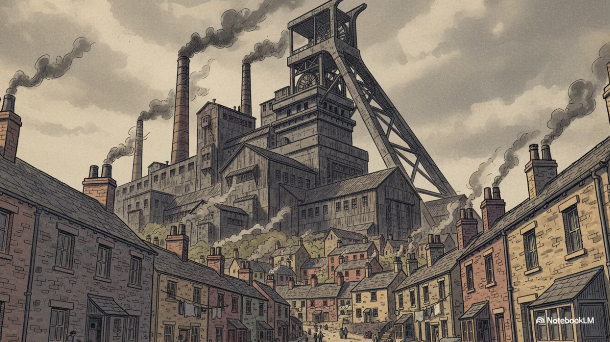
As the demand for oil surged, Polbeth found itself at the absolute epicenter of the Scottish shale oil rush. The landscape was quickly dotted with deep pits and towering mine shafts. The Polbeth Shale-field became highly active, boasting some of the deepest mines in the Scottish shale-fields, such as the workings that reached a staggering vertical depth of 250 fathoms (around 1,500 feet).
Notable local sites included Polbeth No. 11 Pit (often associated with Gavieside) and No. 26 Mine. Working in these mines was gruelling, dangerous labour. The village population exploded as workers flocked to the area to extract the Broxburn and Fells shale seams. It was backbreaking work in pitch-black conditions, but it established a robust, tightly-knit working-class community that would define the region for a century.
The Five Sisters Shale Bings
The most enduring physical legacy of this era is undeniably the Five Sisters Shale Bings, situated just a mile west of Polbeth. Rising to an impressive height of 720 feet (220 meters) above sea level, these massive spoil tips were created by the “tip head men”—workers who bravely tipped hutches of roasting-hot, spent shale from terrifying heights. Today, these towering remnants are a protected scheduled monument, serving as a stark, beautiful memorial to the region’s industrial heritage.
Community and Culture in a Mining Village

As the oil company expanded, so did the need for infrastructure and housing. The story of housing in and around Polbeth is a fascinating study in British social history.
The “Lost Villages” and the Move to Polbeth
During the height of the mining boom, entire villages were built by the oil companies to house their workers, including the nearby settlements of Gavieside and Mossend. These “company towns” were basic, often lacking running water and proper sanitation. By the 1930s and 1940s, local councils began demanding better living conditions, insisting that homes have indoor toilets.
When the oil company balked at the cost of upgrading the miners’ rows in Gavieside and Mossend, the villages were ultimately condemned and demolished. To rehouse the displaced workers, new, modern council housing was constructed in Polbeth, absorbing the populations of the “lost villages” and greatly swelling the size of the modern settlement.
The Engine House and Village Life
The community spirit of Polbeth was remarkably strong, born out of shared hardship and triumph. This ingenuity is perhaps best exemplified by the Polbeth Harwood Church. Originally, worship in the village took place in a rather unconventional setting: the former Engine House of Shale Pit 26! When mining operations eventually ceased at that pit, the industrial engine house was cleverly converted into a community hub. Today, it survives as the beloved Polbeth Village Hall, acting as a living bridge between the village’s heavy-industry past and its peaceful present.
The Decline of the Shale Industry
No boom lasts forever, and the Scottish shale oil industry eventually fell victim to rapid global economic shifts.
A Changing Economy
By the early 20th century, the discovery of vast reserves of cheaper, liquid crude oil in the United States and the Middle East began to undermine the economic viability of extracting oil from shale. Despite government subsidies that kept the Scottish mines open through the World Wars, the industry steadily declined. By 1962, the last of the commercial shale oil operations in West Lothian ceased completely. The fires went out, the deep pits were capped, and Polbeth faced an uncertain economic future as the industrial dust settled.
Modern Polbeth: Regeneration and Nature Reclaimed
The transition from a heavy industrial powerhouse to a post-industrial landscape was challenging, but the resilience of the Polbeth community shone through.
Community Regeneration
In recent decades, Polbeth has undergone significant regeneration. Identified as a key focus area by West Lothian Council, millions of pounds have been invested into upgrading local amenities, creating the state-of-the-art West Calder High School right on the border of the village, and improving local parks. Grassroots initiatives, like the Polbeth and West Calder Community Garden, have flourished, bringing residents together to grow food, manage local woodlands, and stay active in the outdoors.
Nature Returns to the Bings
Perhaps the most poetic chapter in the history of Polbeth is how nature has reclaimed the industrial scars. The Five Sisters Bings, once barren mountains of red shale waste, have slowly evolved into unique, highly bio-diverse ecosystems. They are now home to rare plants, wild orchids, insects, and mammals, proving that nature can heal even the most heavily industrialized landscapes over time.
Why You Should Visit Polbeth Today
Today, Polbeth is an excellent destination for history buffs, nature lovers, and families alike looking to explore a lesser-known side of Scotland.
Local Landmarks and The Shale Trail
If you visit, you can walk a section of the incredible Shale Trail, a 16-mile walking and cycling route that weaves through West Lothian, directly telling the story of the shale people and connecting historic sites. You can also explore the historic Camps Viaduct nearby, an impressive nine-arch 1885 railway structure that once served the local mines and now serves as a scenic walking path.
For family fun, the highly popular Five Sisters Zoo Park sits right on the edge of the village. Established in 2005, it houses over 180 different species of animals, including rescued lions and bears, making it one of the top attractions in West Lothian.
From the quiet “birch pools” of its ancient past to the roaring fires of the shale oil boom, and finally to its modern renaissance as a thriving community, the history of Polbeth is a true Scottish epic. It stands as a testament to the hard work of the West Lothian miners, the ingenuity of inventors like James Young, and the enduring, unbreakable spirit of the people who proudly call this unique village home today.