
Gavieside is One of West Lothians Lost Villages near Polbeth. It was built in 1863 to house the workers of the shale mine of the same name. The village was abandoned in 1939 after the sudden decline of Shale mining due to foreign production taking over.
Gavieside – The Village That Vanished Without a Trace
The village and Shale works of Gavieside were constructed in 1863. This was at the heart of the Black Gold Rush of the Nineteenth Century Industrial Revolution. Just Thirteen Years previously, Glasgow Chemist James Young had started Pioneering the mining and distillation of Shale which sparked a global Boom with the invention of Parafinn. Soon, the Eastern side of West Lothian, the Red East quickly became filled with Shale mining operations and Chemical works such as the Original Durhamtoun works on the Boghead Estate and the bigger works at Addiewell which opened soon after.
Gavieside Shale mine was sunk to fuel this Chemical plant where Shale Oil could be extracted and exported worldwide for use as Paraffin for lamps as well as a range of other products.
Construction of Gavieside
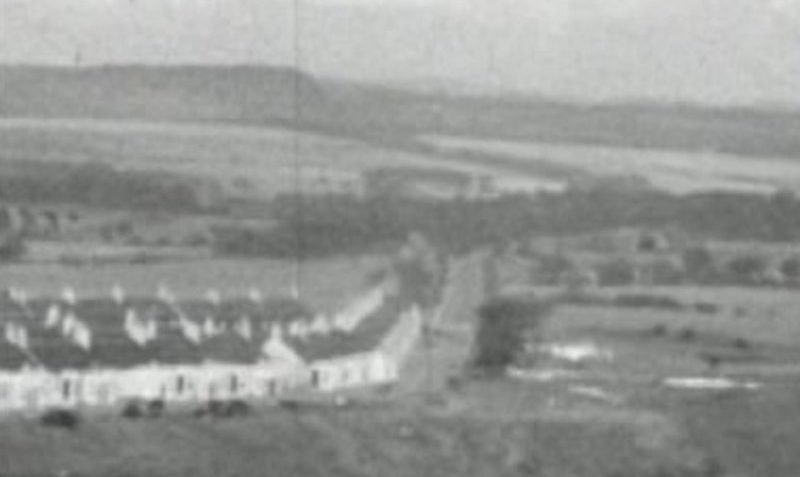
The industrial genesis of Gavieside began in 1862 when Alexander Morrison Fell established the West Calder Oil Company. Situated north-east of West Calder and bounded by the River Almond and West Calder Burn, the site was known locally as “Fell’s Works.” By 1863, Fell had constructed the area’s first substantial oil works, an ambitious complex that required a dedicated workforce.
To house these pioneers, the company erected 110 homes. These were arranged in rows of four to ten, forming a stark line that faced Polbeth Road. Crucially, the village was built backing onto the damp, unstable terrain of Briestonhill Moss—a geographic compromise that would eventually seal the village’s fate.
Life on the Rows
The original Gavieside village consisted of roughly 110 homes. These were not built for longevity; excavations reveal they were constructed with minimal foundations, often directly onto the peat of ‘Briestonhill Moss’. This “worker containment” philosophy prioritized proximity to the pithead over human health.
The 1914 Condemnation Criteria:
- “Back-to-Back” Housing: 44 dwellings were built back-to-back, a design that prohibited cross-ventilation and trapped dampness.
- Sub-Surface Construction: Many houses were built below the level of the road, making them perpetual targets for runoff and poor drainage.
- Total Lack of Sculleries: Dwellings lacked wash-houses, coal cellars, or internal water facilities.
- Sanitary Failure: Residents shared a few communal water stand-pipes and relied on primitive “dry privies.”
These structural failures at home were matched by the extreme mechanical and geological risks found hundreds of feet below the surface.
The Tragedy of the Plummeting Cage
On Monday, March 16, 1885, at the No. 11 Gavieside Pit, a catastrophic mechanical failure occurred. An inspection later revealed that a bolt in the shaft slides had loosened, causing some 9 feet of the slide to be dislodged. A descending cage jammed on the broken slide, then suddenly plummeted 30 fathoms (180 feet), throwing its occupants to the bottom.
Victims of the No. 11 Pit Accident
- Samuel M’Currley (20): Fractured skull and severe head injuries.
- Thomas Dugan (19): Body so mutilated as to be unrecognizable.
- Andrew Sanderson (15): Fractured head and two broken arms.
- Alexander Bulloch (13): Broken thigh, ankle, and facial lacerations.
Note on Survivors: Matthew Howieson (23) and Thomas Reid (13) miraculously survived; Reid was shaken but was able to walk home.
This tragedy emphasizes the intergenerational sacrifice of the shale era. Today, the legacy of these pits—the unstable ground and the 16-fathom failure points—dictates the modern “no-build zones” that shape the 2025 masterplan.
The Demise of the Village
The Fist signs of despair for Gavieside was when the West Calder Oil Company went Bankrupt in 1885. The village and the Shale Mine were quickly bought over by Davidson Parafinn Company. However, this didnt mean saviour for the Gavieside pit. Instead, Davidsons stripped the pit workings down for parts which the quickly wheeled away to be used on the company’s other workings throughout West Lothian.
At the turn of the Twentieth Century, Shale mining in Scotland started drawing to an end. With the discovery of much more potent fossil fuel sites in America and Arabia, the demand for Scottish Shale soon dried up. By 1930, the town had become dilapidated and the Village was finally abandoned in 1939 and the residents were rehoused in the neighbouring village of Polbeth.
The New Gavieside
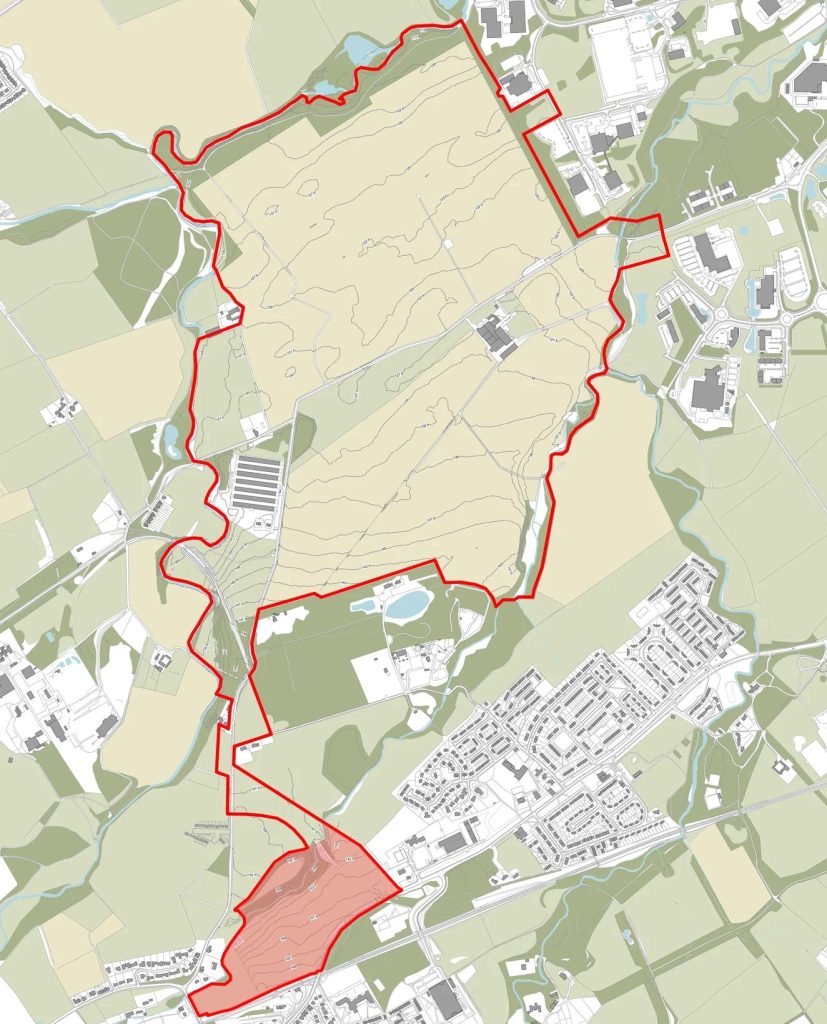
Today, Persimmon homes have started work on resurrecting the Village of Gavieside, building New state of the art homes in place where the former buildings lay.The modern vision for Gavieside Village, validated in February 2025, is a collaborative effort between Collective Architecture, LUC (Landscape Architects), and Dougall Baillie Associates (Engineers). Working for Persimmon Homes, this team has designed a “Blue-Green” neighborhood that treats the industrial heritage not as a liability, but as a framework for restoration.
Strategic Framework for 2,800 Homes:
Intergenerational Resilience: Moving away from the segregated “rows” of the past, the plan integrates a primary school, community enterprise hubs, and diverse housing types to create a self-sustaining, multi-generational community.
Blue-Green Infrastructure: Rather than hiding drainage in pipes, the plan celebrates the “water journey.” It utilizes rain gardens, reedbeds, and wetland habitats to manage the site’s historical contamination and complex hydrology.
Pedestrian-Centric Village Centre: In a radical departure from car-dominant 20th-century planning, primary vehicular routes are arranged to avoid cars and major junctions within the Village Centre. Streets are designed as active, safe corridors for movement.
A Comparison of the Two Villages
| Feature | The 1860s Mining Row | The 2025 Village Plan |
|---|---|---|
| Primary Goal | Industrial output and worker containment | Low-impact living and ecological net gain |
| Housing Quality | Back-to-back, below road level, no sculleries | High-spec, low-carbon, sustainable homes |
| Environmental Impact | Waste ratio of 8:10; creation of massive bings | Blue-green infrastructure; habitat restoration |
| Mobility | Mineral railways for shale/coal transport | Active travel corridors and car-free centers |
| Foundations | Built directly onto peat (temporary) | Integrated into resilient landscape framework |