
Before the sprawling shopping centres, modern housing estates, and complex roundabouts of today’s New Town, the landscape of West Lothian was defined by a very different industry. Long before the 1960s, the area was the beating heart of the world’s first oil boom. At the center of this industrial revolution was Livingston Station, a bustling, purpose-built mining village that housed the hardworking families of the Scottish oil shale industry.
The Old Village of Livingston Station
Though the original village has since been absorbed into the modern district of Deans, the history of Livingston Station offers a fascinating glimpse into Scotland’s industrial past, tight-knit mining communities, and the dramatic transformation of the West Lothian landscape.
The Birth of Livingston Station
The story of the village cannot be told without first understanding the industry that built it. While today we associate oil rushes with Texas or the Middle East, the mid-19th century saw West Lothian become the global pioneer of the oil industry.
The West Lothian Oil Shale Boom
In 1850, a Scottish chemist named James “Paraffin” Young patented a process for extracting oil from coal and, later, from oil shale. The rolling hills of West Lothian were incredibly rich in this grey, sedimentary rock. By 1870, the region was mining over three million tons of shale every single year, processing it to extract lamp oil, paraffin, lubricating grease, and agricultural fertilizers.
To capitalize on this booming market, the Pumpherston Oil Company established the massive Deans Oil Works. However, they faced an immediate logistical challenge: where would the thousands of necessary workers live? The answer was to build entirely new, self-contained company villages. Between 1905 and 1910, the Pumpherston Oil Company constructed a substantial settlement to house their workforce. This settlement became known as Livingston Station.
The Arrival of the Railway
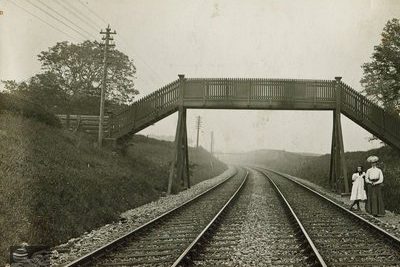
The village took its name from the nearby railway station, which had actually predated the housing by several decades. The original railway station, operated by the Edinburgh and Bathgate Railway, opened its doors on November 12, 1849.
Sitting roughly a mile north of the ancient, medieval settlement of Livingston Village, this vital transport hub became the geographical anchor for the new oil workers’ community. From then on, the settlement was universally known as Livingston Station.
Life in the Village of Livingston Station
Unlike the haphazard slums of early industrial cities, Livingston Station was a planned community. It was designed to keep the workforce healthy, content, and highly productive.
The Company Houses and “The Rows”
The layout of Livingston Station was typical of Scottish mining villages, defined by straight streets known as “Rows.” The village comprised several main thoroughfares, including Main Road, Glen Road, Dean Street, North Street, Mid Street, and South Street.
A 1914 report by the Royal Commission on Housing Conditions provides a vivid snapshot of the village at its peak. At that time, Livingston Station consisted of 179 houses accommodating a population of 1,105 people. For a weekly rent of four shillings, a miner and his family were provided with a two-room house that featured a kitchen, a generous scullery with a boiler and sink, and a coal cellar. Homes at the ends of the rows even boasted an attic bedroom.
The Pumpherston Oil Company took pride in the village’s upkeep. Most houses had private front gardens, drying greens fenced with iron railings, and daily refuse collection provided by the company.
Community, Recreation, and the Institute
Life in Livingston Station was incredibly tight-knit. The village was largely self-sufficient, featuring a Co-operative store, a local school, and a small church.
At the heart of the village’s social life was the Deans Works Institute. This community hub offered a library, a games room for dominoes and draughts, a snooker room with full-sized tables, and spray baths for the workers. Outside, a pristine bowling green was fiercely guarded by the village elders, while children enjoyed company-provided swings and play centers.
The highlight of the year was the annual Gala Day, held in mid-June. Homes were spring-cleaned, front steps were freshly whitewashed, and the whole community came together for a week of sports, visiting funfairs, and lively celebrations that temporarily erased the exhaustion of the gruelling shale pits.
Famous Faces: A Footballing Legacy
For a village that barely exceeded a thousand residents at its peak, Livingston Station possessed an astonishing athletic pedigree. Incredibly, this tiny mining community produced three international footballers who went on to represent Scotland.
- Willie Waugh: Born in the village in 1910, Waugh was a talented goalkeeper who played for Heart of Midlothian and Hibernian. He earned a cap for Scotland in 1937 during a 5-0 victory over Czechoslovakia.
- Tommy Walker: Born to a shale mining family in 1915, Walker became a true Scottish footballing legend. Earning 21 caps for his country, he famously scored the equalizing penalty against England at Wembley in 1936, before returning in 1938 to score the winning goal against the “Auld Enemy.” He later enjoyed immense success as the manager of Hearts.
- Jimmy Scoular: Born in 1925, Scoular was a formidable player known for his relentless energy and passion. He played for Portsmouth and Newcastle United, winning nine caps for Scotland in the early 1950s before transitioning to a successful managerial career.
The Decline of the Shale Industry
Despite its vibrant community, the fate of Livingston Station was tied exclusively to the price of oil. In the early 20th century, the discovery of vast reserves of cheap, liquid oil in the Middle East and the Americas began to undercut the Scottish shale industry.
Extracting oil from solid rock was labour-intensive and expensive. While government subsidies during the World Wars briefly kept the industry afloat, the post-war era signalled the end. The Deans Oil Works and surrounding pits eventually closed, leaving the residents of Livingston Station without their primary source of employment. Furthermore, the original railway station that gave the village its name had already ceased passenger services in 1948.
The Transformation into the New Town
In the aftermath of the Second World War, the UK government sought to alleviate extreme overcrowding in cities like Glasgow. The New Towns Act of 1946 set the stage for massive urban redevelopment across the Scottish central belt.
From Old Village to Modern Deans
On April 16, 1962, the New Town of Livingston was officially designated. The master plan for this sprawling new urban center engulfed several historic settlements, including the ancient Livingston Village, Bellsquarry, and the industrial community of Livingston Station.
As the Livingston Development Corporation (LDC) began constructing modern housing estates and industrial parks, the old miner’s rows of Livingston Station were marked for demolition. Throughout the 1960s and 1970s, the company houses on Main Road, Glen Road, and Dean Street were systematically torn down. The village was entirely redeveloped and officially absorbed into the new district known as Deans.
In 1986, to serve the booming New Town, a new railway station was opened just east of the original 1849 site. However, the historic name was lost to time; the new stop was named Livingston North.
Remembering Livingston Station Today
Today, very little physical evidence remains of the original Livingston Station village. A few later-built villas and the occasional repurposed community building survive amidst the modern suburban streets of Deans.
However, the legacy of the village—and the industry that birthed it—is forever carved into the landscape of West Lothian. The famous “bings” (massive, reddish-pink hills made of spent shale waste) still loom over the modern town, serving as striking monuments to the miners who once lived and toiled there.
While the New Town of Livingston looks toward the future as a hub of modern retail and technology, the forgotten story of Livingston Station remains a vital chapter in Scotland’s industrial heritage—a tale of hard work, tight-knit community, and the ever-changing face of West Lothian.