
When we speak of historical displacement in Scotland, the mind immediately wanders to the mist-shrouded glens of the north: the tragic spectacle of the Highland Clearances, burning thatch, and families driven onto ships to make way for sheep. But a quieter, arguably more systemic revolution occurred decades earlier across the rolling hills of West Lothian. This was the Lowland Clearances—a movement that lacked the immediate violence of the north but was no less total in its erasure of a way of life.
Scotland’s Other Clearances
Known by its architects as the “Great Improvement,” this era fundamentally redrew the Scottish landscape. While the Highlands suffered the torch, the Lowlands were transformed by the ledger. Beneath the neat grids of today’s enclosed fields lies a buried history of the West Lothian peasantry, whose centuries-old communal world was systematically dismantled in the name of progress.
The Pen Was Mightier Than the Torch
The fundamental difference between the Highland and Lowland displacements lies in the method of removal. In West Lothian, the displacement was bloodless, executed in ink. There were no soldiers and no burning rafters—only the cold, non-negotiable mechanics of property law and agrarian capitalism.
Between 1760 and 1830, West Lothian lairds sought to modernize their estates with a singular focus on efficiency. Where a single tract of land once supported ten families living at a subsistence level, the new model demanded that same land be consolidated and leased to one well-capitalized tenant farmer.
The primary weapon of this transformation was the expiration of leases. When communal agreements ended, they were simply not renewed. This was a bureaucratic eradication. The people were forced off the land not by the bayonet, but by the quiet, inexorable scratch of a nib on a legal document.
The Clearances of the Fermetoun
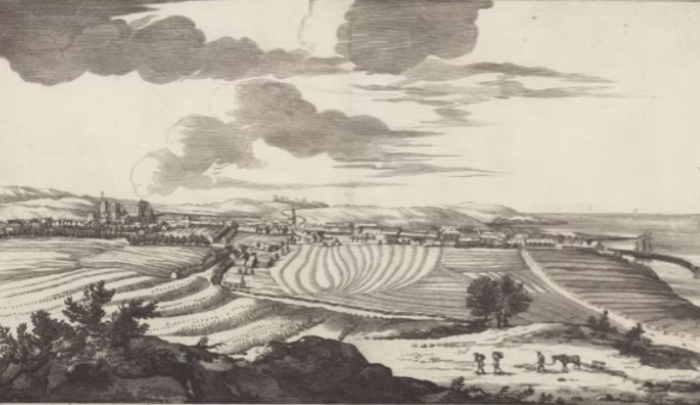
Before the “Great Improvement” swept through the county, the rural population lived in fermetouns—organic clusters of five to twenty families. These settlements were built from the earth itself, featuring low-slung cottages of unmortised stone and turf. Within these hamlets, life was deeply interconnected, housing joint-tenants, sub-tenants, and “cottars” (landless laborers).
The heartbeat of the fermetoun was the “runrig” system. Fields were divided into long, narrow, curving strips called “rigs,” which were periodically reassigned by lot to ensure fairness in soil quality. While later “Improvers” would dismiss this as agonizingly inefficient, it served as a vital communal safety net.
“The heavy, cumbersome wooden ploughs of the era required teams of six to eight oxen or small horses. No single tenant owned such a team; they had to pool their animals, their labour, and their tools. If a farmer fell ill, the community ensured his rigs were sown and harvested. Survival was a collective enterprise.”
The High Price of ‘Rational’ Progress
However, the catalyst for this upheaval was the Scottish Enlightenment. Following the loss of feudal powers after the 1746 Jacobite Rebellion, the Scottish nobility began measuring their prestige through rental income and crop yields rather than armed retainers. Influenced by the “rational” theories of Adam Smith, West Lothian’s elite began treating their ancestral lands as scientific laboratories.
But then, the “Improvers” viewed the traditional Fermetoun not just as poor economics, but as a moral failing. To the aristocratic eyes of the Earls of Hopetoun or Charles Stirling of Muiravonside, the communal system was defined by “weeds, exhausted soils, and communal lethargy.” The drive toward efficiency became a crusade to replace the “messy” human element with scientific rigour.
The Scenic Landscape is an Engineered Artefact
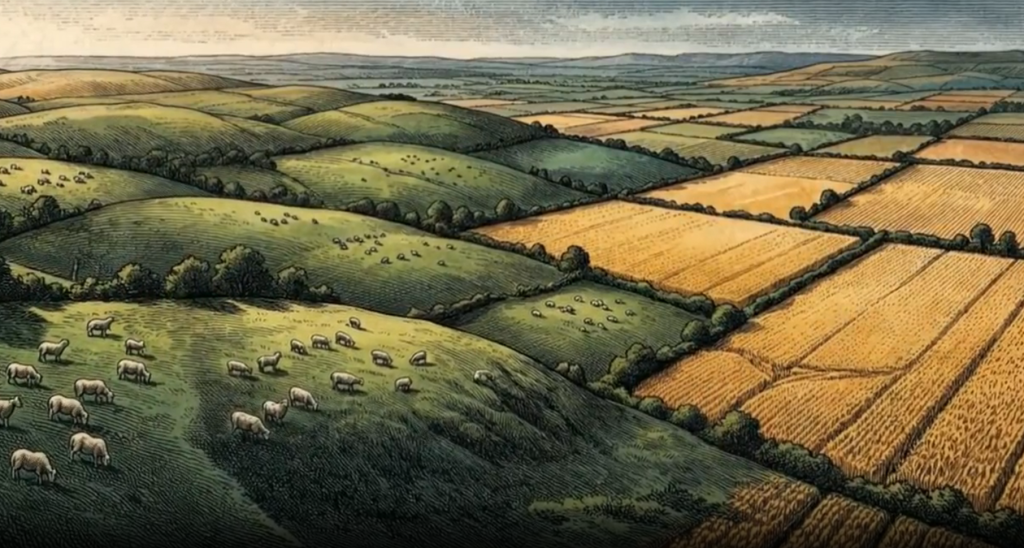
The “peaceful, timeless” look of modern West Lothian is a manufactured map. The geometric blocks of fields bounded by hawthorn hedges and “drystane dykes” (dry stone walls) are the physical manifestations of the Clearances. This landscape is an engineered artefact, built atop the deliberate erasure of the peasantry’s geography.
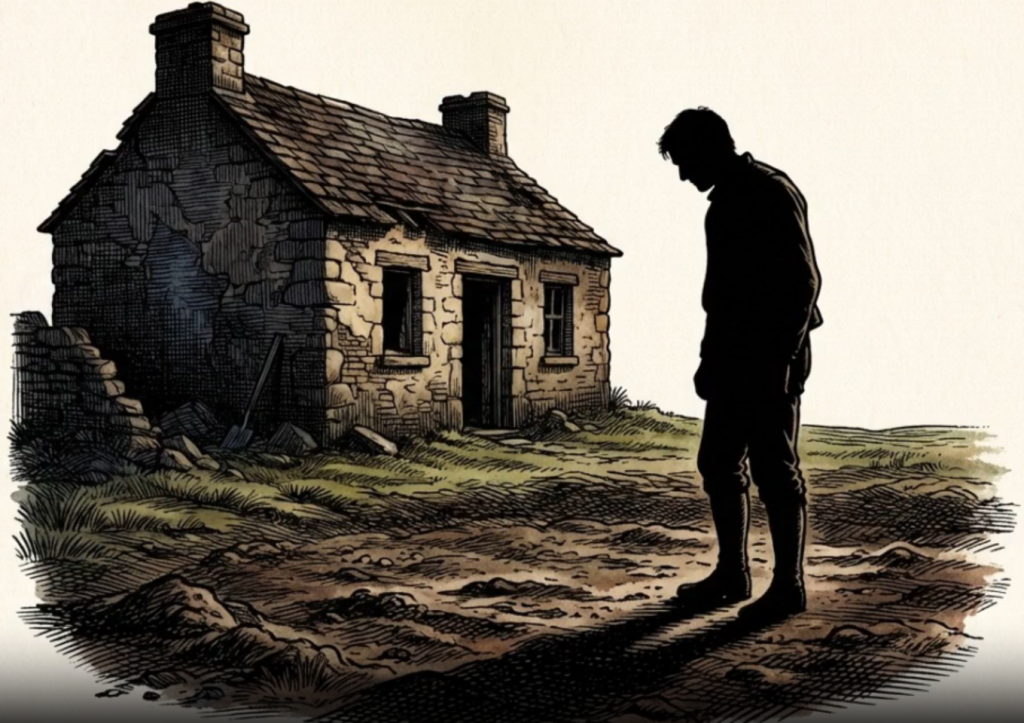
In the coastal Parish of Carriden, the physical alteration was absolute. Ancient communal landmarks, including the “concave cisterns” and wells that had sustained fermetouns for generations, were filled and levelled to create flat, uninterrupted plains for the plough.
“The records show the deliberate destruction of their homes. Estate memorandums frequently contain notes instructing the demolition of old cottages to make way for modern farm steadings—Then imposing, slate-roofed houses designed for a single, wealthy tenant farmer.”
The Fuel for the Industrial Fire
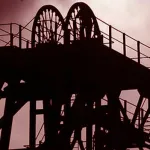
As this Agricultural Revolution was drawing to an end, a new type of revolution was just beginning to gather force. The Industrial revolution of the 19th century would provide the fire for this surplus labour to be burned in. However, the thousands of people displaced from the West Lothian soil did not vanish; Instead, they became the essential, desperate workforce for Scotland’s Industrial Revolution. So, they were driven from the open air of the “runrig in the sun” into the “black economy” of the coal pits and shale mines.
Although, many remained on the land as the “rural proletariat,” living in spartan “bothies” and existing almost entirely on a diet of oatmeal and milk. Although, others migrated to burghs like Linlithgow and Bathgate, trading the country air for cramped, unsanitary tenements.
By the mid-19th century, these families provided the labour for James “Paraffin” Young’s shale oil boom. So the descendants of independent farmers became the miners living in the iconic “red-brick miner’s rows” beneath the looming pink shale bings. But, they were driven underground into the claustrophobic and dangerous conditions of the pits. A literal descent from the communal light into industrial shadow.
The Dual Legacy of the Lowland Clearances
The legacy of the Lowland Clearances is a study in tension. Economically, the “Great Improvement” was a triumph. It saved Scotland from periodic famine. Funded the infrastructure of a modern nation, and turned the Lothians into a global beacon of scientific agriculture.
Yet, the cultural cost was the total destruction of a centuries-old way of life. Today, the memory of the Fermetoun survives only in “ghost geography.” Although, you can find it in the linguistic echoes of place names like Houston or Riccarton. Here the “toun” suffix marks the site of a vanished village. Or in the faint “ridge and furrow” patterns visible from the air in the Bathgate Hills.
As we admire the neat, green fields of the Lothians today, we must ask ourselves: Is progress truly progress if it is built upon the quiet trauma of erasure? Beneath the serene, scenic rural view lies the history of thousands of lives moved by the pen. Reminding us that our modern world was born from the sacrifice of the communal soul.