
Today, were taking a look at a revolution that didnt just change Scotland, it completely redrew its map and rewrote its social contract. We’re going to follow the journey from the grain based Scottish Lowlands to thee Cash driven Economy that took it’s place. This is a true story of Grain that turned to Gold.
From Grain to Gold
Grain turning to Gold? It sounds almost medieval doesn’t it? But for centuries, this was the reality for most farmers in the Scottish lowlands. For them, rent wasn’t about money. It was about the actual crops they pulled from the soil. Moving away from that system wasn’t just a small tweak. It was a massive shift that was about to change everything.
The World of Grain
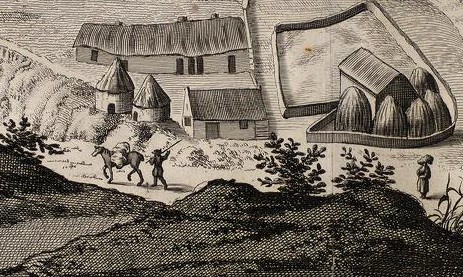
So, in order for us to to really understand just how massive this revolution was, we need to step back in time. e need to try and understand a world that has long been swept away. A world built not on Individual profit, but on ancient traditions, Community ties and the unchanging rhythms of the seasons.
You see, the heart of rural society in those days wasn’t the individual farm that we often picture today. It was the ‘Fermetoun’. Just picture a small cluster of families in a small area in West Lothian, all working the land together. The fields were all divided into strips, all shuffled around each year. It was a life built on community, even if it wasn’t necessarily the most efficient way of doing things.
Now the biggest deal in life for most was paying the rent and you paid it in kind. Most of it was ‘fermed’. Huge deliveries of grain. Then you had ‘Kind’, which was pretty much everything else. From chickens to cheese. So think about it.In this system, the land owner wasn’t just your Landlord, but your single, biggest, most powerful customer.
Why Landlords liked Grain
So why did these systems stay in place for so long. Well, for the landlords, it was a very smart, economic move. Payment in grain kinda protected them from Scotland’s temperamental currency. It also gave them a physical product that they could sell when its price was at its highest. But the best of it for them was that it almost locked tenants out of the market which meant all the economic power stayed right in the hands of the laird.
The Drive for Improvement

But, by the Eighteenth century, things were starting to take a shift. A powerful new Idea was beginning to spread its way across Scotland. An Idea which saw these ancient ways not as a good idea, but as a road block to progress. The ‘Buzz word’ of the day was ‘Improvement’. This Idea came straight out of the Intellectual energy of the ‘Scottish Enlightenment‘. It was all about reason, efficiency and relentless progress. When you applied that level of thinking to farming, it meant only one thing – Maximising profit at all costs.
But this kind of Improvement wasn’t just gonna take some new policy or another. This meant an absolute overhaul of rural life as the people knew it up until then. It involved dismantling those communally run Farmstead communities and brining in single tenant farms. It meant levelling huge open fields and enclosing them with stone walls or hedges of trees to break the wind. But right at the heart of it all was a fundamental change in rented stock.
From Crop to Cash
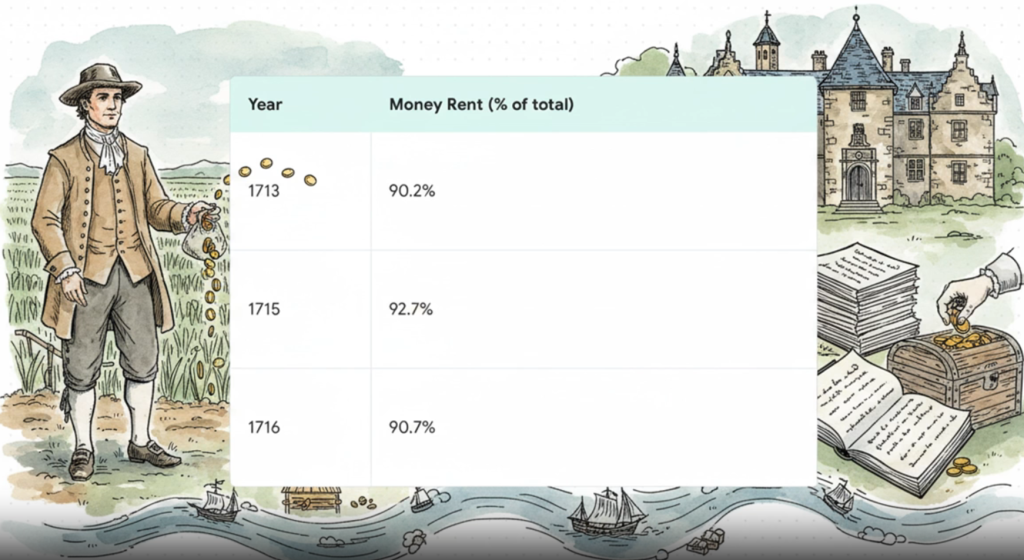
So that brings us right to the economic engine of this entire revolution. The great shift from paying rents with crops to paying it with cold hard cash. For the landlords, moving the money meant handling their estates a whole lot simpler. But it also left their income vulnerable to price fluctuation. For tenants, it was a double edged sword. It gave them the freedom to sell their produce on the open market for sure. But it also exposed them to the harsh realities of ‘Supply on demand’ for the very First time.
Now, even though this huge shift to cash picked up steam in the middle of the Eighteenth Century, It didnt happen everywhere at Once. Some places were way ahead of the game. Take for Instance, the Walsham barony in Lanarkshire, just outside of West Lothian. By 1713, over 90% of It’s rent was already being paid in cash. It just goes to show that some landlords were embracing this new commercial mindset decades before everyone else.
So, Once the Farms had been Improved and the rent flipped to cash, what did that actually mean for the tenant? Well, the cost of living didnt just rise. It sky rocketed. Across these new commercialised estates, rents typically exploded between three and a Half and Four times. This was all within a single generation too. But you have to understand, this wasn’t just some unfortunate side effect. It was a deliberate strategy. Proponents such as Sir John Sinclair, a major figure in the Improvement movement openly argued that a Four fold rent increase wasn’t just reasonable. It was desirable. The logic was pretty brutal. it would force tenants to become enterprising and efficient otherwise theyd be swept aside.
The Price of Progress
But of course, like most things, this economic revolution came at a cost. A really profound and tragic human cost. For this new, improved world to be born, the old world had to be dismantled and that meant displacing the very people who called it home.
Now we’ve all heard about the Highland clearances. But a process that was similar though perhaps quieter, was happening all across the South. The Lowland clearances saw Thousands of families evicted from the lands their ancestors had worked for centuries. This mass replacement really showed its peak between the 1760s and the 1830’s. It was like a slow motion catastrophe that reshaped the entire lowlands of Scotland.
All across West Lothian, communities that had existed for generations simply ceased to exist. they completely vanished from the map. The reason why was simple – Cold Economics. The Old system could support several families on a single piece of land. But the new model demanded a large single, more efficient farm run by just a single tenant family and a small handful of labourers.
For the Thousands of smaller farmers and their families, there just wasn’t a place for them anymore. For those who were forced from their land, the loss was just immeasurable. As one evicted farmer, John Younger wrote; “It wasn’t just losing our home. But it was the murder of all our nearest and dearest ties”. It was the severing of their community, their history and their whole Identity.
A Landscape Transformed
So, after decades of all this upheaval and removal, what was the result? It was a Scotland that was fundamentally new. For it’s landscape, its economy and it’s people. When the writer William Coddit was visiting the newly improved farms of the Lothians in the 1830’s, he was completely struck by their ruthless efficiency. Seeing the new steam powered machinery at work, he wrote that it was almost as if technology itself had been recruited for the task of sweeping the people from the face of the earth.
But, the Legacy of this Revolution was permanent. The ancient ‘Fermetoun’ was long gone, replaced by the large stone walled fields that we still see today. The displaced population would become the fodder for the growing industrial cities of Glasgow and Edinburgh. Or they sought new futures far across the sea in North America and beyond. The social and Physical landscape of the Lowlands was changed for good.
There is absolutely No question that this Agricultural revolution made Scottish Agriculture the most productive in Europe. It generated immense wealth and it fed the factories of the Industrial revolution. But looking back on the erased communities and the human cost, we are left with a lasting and difficult question; Was the Price of this progress just too high? was all this displacement and human cos really necessary for progress?