
If you wander just a few miles east of Linlithgow, you’ll find the village of Bridgend. While it appears as a quiet, modern residential settlement today, the ground beneath your feet tells a much louder story. This was once a frontier of the 19th-century industrial expansion, a place where the landscape was carved and reshaped by the hunt for Scottish shale oil.
The Birth of a Village (1885–1886)
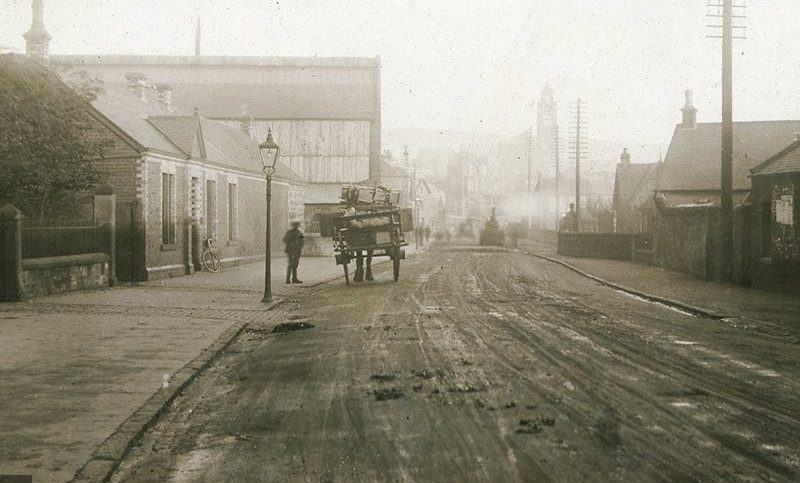
Bridgend was not a village that grew slowly over centuries. It was born of fire and industry. Between 1885 and 1886, the village was established specifically to house the workforce for the Champfleurie Oil Works.
“Bridgend was founded between 1885–86 to serve as housing for the Champfleurie Oil Works in Linlithgow before its closure in 1902.”
Before the works closed at the turn of the century, the village existed as “worker rows,” a community built on the logic of proximity to the retort and the mine. It was a functional, controlled environment, typical of the era’s industrial settlements where the company provided the roof over your head, but—tellingly—never a pub.
The “Shale Canyon”: Industrial Might and Tragedy
If you step into the strip of woodland east of the village today, the atmosphere changes. It is a quiet, eerie landscape where twisted roots and mossy pools have reclaimed what was once a site of immense toil. This is “Bridgend’s Shale Canyon,” where James Ross & Co. extracted the grey shale for their Philpstoun Oil Works.
Initially, the firm sank the Philpstoun No. 4 Pit around 1884, but by 1903, they shifted to opencast quarrying to secure supplies against the threat of miner strikes. A mineral railway once bridged the Union Canal and crossed the old A9 on the level near Gateside to carry the “blue gold” to the works.
Unique Features of the Shale Canyon:
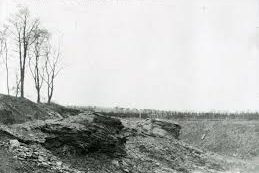
- Deep Cuttings: Steep-sided rock walls where the mineral railway once descended to the quarry floor.
- The Mineral Railway Path: Now often serving as a stream bed, the tracked is a silent witness to the rattle of the old hutches.
- The “Blue Lagoon”: A flooded, deep section of the abandoned workings.
- Exposed Seams: You can still see the steeply inclined seams of Broxburn and grey shale outcropping in the rock faces.
- Nature’s Reclamation: In the spring, delicate clumps of snowdrops highlight the ruins of pithead buildings, while local “weans” still play among the hollows, perhaps proving that shale mining truly runs in the genes here.
A Sombre Sidebar: The Tragedy of John Nailon
On December 11, 1908, the canyon’s industrial might turned deadly. A massive 50-ton fall of shale entombed two workers at 6:00 AM. While John Dales was rescued after hours of agonizing effort, 32-year-old John Nailon was not so fortunate. A resident of nearby Kingscavil, Nailon was a local hero on the pitch, a talented footballer for the Philpstoun Rangers. His loss was felt deeply across the community, a reminder of the price paid for West Lothian’s industrial progress.
Architectural Heritage: Bridgend Farm
Bridgend is also home to a magnificent piece of agricultural history. Bridgend Farm is a mid-to-late 19th-century quadrangular steading, designated as a Category B listed building (LB7472). Built with stugged sandstone rubble and striking crowstepped gables, it remains a rare example of high-quality Victorian farm architecture.
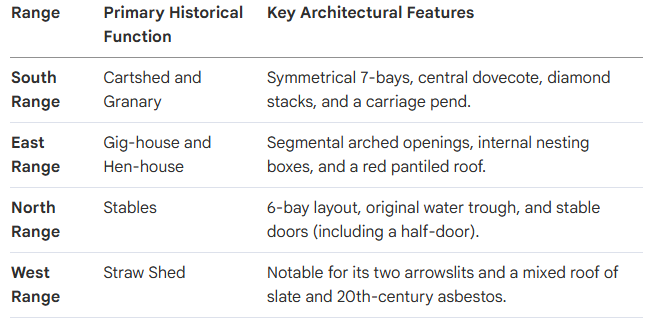
Interestingly, the social history of the farm continued well into the 20th century. In the 1920s, a pair of cottages forming a T-plan extension were modernized with sculleries and lavatories—small but vital improvements that reflect the changing standards of living for West Lothian’s rural workers.
Bridgend and the “Lost Villages”
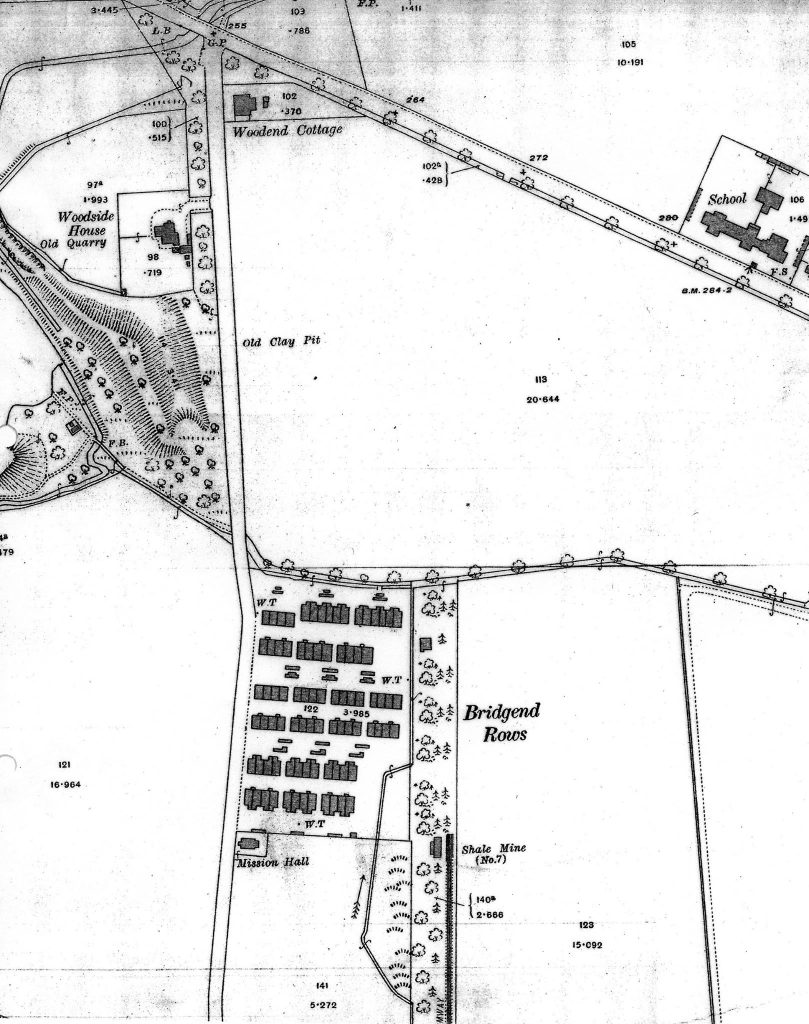
Local historian Sybil Cavanagh often speaks of the “Lost Villages” of West Lothian—communities that flourished for less than a century before vanishing. Bridgend’s modern face is actually a result of this phenomenon, specifically its relationship with the neighbouring village of Kingscavil.
The Slum Clearance Era
Kingscavil, built in 1885, was once a thriving row of 114 houses. However, by the 1930s, these industrial dwellings had fallen well behind modern standards. Because government grants were only available for “slum clearance,” the local council was forced to demolish these communities rather than renovate them.
The Re-housing Phase
The “lost” people of Kingscavil needed a home. In the early 1930s, new council housing was constructed in Bridgend to accommodate those displaced by the demolition of the old rows. This transition transformed Bridgend from a temporary worker outpost into a permanent, modern community.
A Legacy of Service: The Story of Private Alexander Arnott
The human element of Bridgend’s history is best captured in the life of Alexander Johnston H. Arnott. Born in Bridgend in 1883 (as recorded in the 1891 Census), Alexander was a true son of the district. A student of mining at the Coatbridge Technical College and an employee at Rosehall Colliery, he was a man who looked toward the future of his industry.
Service Profile:
- Residence: Bridgend, Bathgate (later lived in Airdrie/Coatbridge).
- Battalion: 2nd Battalion Seaforth Highlanders.
- Letters Home: Alexander famously wrote four letters to George Murdoch, the Principal of his college, documenting his experiences at the front.
- Sacrifice: He was killed in action on April 25, 1915, during the Battle of St. Julien. He was not the only one in his family to fall; his brother James was lost just months later at Loos.
Modern Bridgend: Community and Continuity
While the quarry is now a “Blue Lagoon” and the Champfleurie works are long gone, Bridgend has reinvented itself. It is no longer a “controlled” company town, but a vibrant village with a strong identity.
Bridgend Today:
- Education & Support: The village is home to Bridgend Primary School and a dedicated community centre.
- Sporting Life: The spirit of John Nailon lives on through Bridgend United, the local football team.
- Leisure: Residents enjoy a local golf course and proximity to the scenic walks of the Lothian landscape.
- Spirit: The village maintains a high population density (approx. 2,550/km²), fostering the “friendliness and security” often remembered by those who grew up in the old rows.
Conclusion: Preserving the Past
Bridgend is a place where layers of history overlap. You can walk from a 1930s council house to a 19th-century farm steading, then descend into a “shale canyon” that once fueled the British Empire. Even the nearby Union Canal tells a story of competition; the Slamannan Basin was built in 1836 to help passengers cut four hours off their journey to Glasgow by rail, only to be rendered obsolete by the parallel Edinburgh to Glasgow Railway just years later.
These physical remnants—the sandstone, the shale, and the water—are reminders of the resilience of our West Lothian ancestors. They remind us to value our community and, in the words of the West Lothian 50+ Network motto:
“Make the rest of your life the best of your life.”