
You know sometimes, when youre walking through a park or nature reserve, you feeling like youre walking through history? well, today we’re going to be discovering a place just like that. The Vanished village of Oakbank in West Lothian is a story about a lost community. yet its hidden right there in plain sight.
If you go there today, you will find Oakbank Bing. This is a beautifully landscaped environment with a walking route, wildlife and some stunning scenery. It just looks like a perfect slice of the Scottish countryside. It really looks like it has been there forever. you know, like a natural hill with these amazing views. The absolute picture of peace and quiet. But, what if this landscape was man made? A relic of a vanished community?
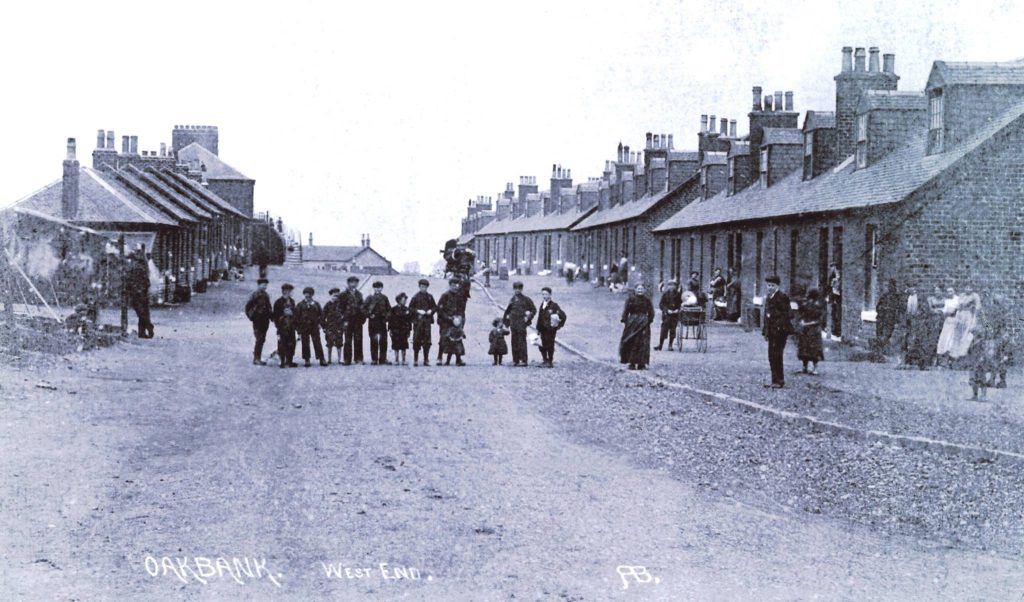
Oakbank – A Prosperous Company Village
But what if I told you that this green hill isn’t natural at all? That it’s actually a monument to a forgotten industry, and that hidden beneath the grass and trees are the ghosts of a whole bustling village that just vanished? Well, that’s the real story of Oakbank.
Forging a Landscape
So, to get to the bottom of this mystery. The Man made hill and the village that vanished, we have to go back in time. Way back. Right into the middle of Scotland’s Great Nineteenth century oil rush. Oakbank village was a purpose-built mining settlement that sprang up between 1864 and 1890 to house the workforce of the Oakbank Oil Works.
The village was artificially created because the booming shale oil industry required a massive workforce, and workers needed accommodation within walking distance of the mines and works. The Oakbank Oil Company ran the village in a paternalistic manner, taking full responsibility for building the homes and providing local amenities for the workers and their families
The Growth and Living Conditions
In 1868, Oakbank consisted of two two-storey blocks, one single-storey row, and several temporary huts used to house the men constructing the oil works. By 1890, the company had expanded the village significantly, building additional two-storey blocks, single-storey back-to-back rows, and more conventional “through houses”. By 1914, there were between 165 and 190 brick houses, which accommodated miners alongside firemen, retortmen, labourers, and watchmen.
Living conditions were highly basic and tightly controlled by the company. A 1914 housing report described houses consisting of just a room and a kitchen, or a kitchen and an attic. There were no indoor bathrooms; water had to be carried in buckets from communal standpipes in the street, and outdoor wash-houses (where fires were lit under large coppers to wash clothes) were shared by four families. The village relied on outdoor privies and ash pits, which were emptied weekly by a company man with a horse and cart. Because all houses were tied to employment, losing a job meant a worker also lost their home.
A Thriving Community Life
Despite the harsh conditions, Oakbank developed a vibrant, self-contained community life. The company built an Institute Hall—equipped with games, newspapers, and a billiard hall designed to keep workers away from “less beneficial” attractions, as the company did not allow a pub in the village. This was the case in all of the mining companies company towns and villages. Pubs meant people talking to each other. People talking led to ortganisation and the last thing these companies wanted was back chat from the workforce.
Oakbank was the largest of West Lothians 20 lost villages. The village eventually boasted a primary school (opened in 1901), a Co-operative Society store (formed in 1872), a mission chapel, a bowling green, and a football pitch. It even had its own Nine Hole Golf club. It also had an aerial ropeway that transported shale from the Dedridge mine.
Social life flourished with annual Gala days, a Burns Club, a tennis club, a Women’s Rural Institute, a rifle club, and local football teams. By 1917, records show that the village’s population had risen to over a Thousand residents supported by 165 houses.
The 1921 Tragedy
A devastating tragedy struck the community early on March 6, 1921, when a fire broke out in a two-storey tenement. The village fire hydrants proved inadequate to fight the blaze. Fanned by strong winds, the fire rapidly destroyed twelve houses, leaving 57 people homeless and claiming the lives of three residents who were overcome by smoke
The Decline and Fall of Oakbank
The fall of the village was triggered by the closure of the Oakbank Oil Works, its sole raison d’être, which shut down in 1931 and were dismantled around 1932. This was a severe blow to the community, forcing hundreds of unemployed men to look for work outside the district.
While the community adapted by creating small-scale agricultural allotments, and World War II temporarily solved local unemployment, the village’s housing stock was steadily deteriorating. After the war, the village still maintained a primary school, two shops, and a football team, but residents gradually began abandoning the outdated company houses for modern accommodation in East Calder
The progressive demolition of Oakbank began in the 1950s. The village’s 120-year lifespan officially came to an end when its very last resident, a shopkeeper named Mrs. Shearer, finally moved out in 1984, allowing the bulldozers to demolish the last remaining home