
If you’re Travelling Between East Whitburn and Blackburn you will pass Swineabbey farm. A humble looking cottage on the main road. But It does have an eye catching view in the field out the back of the building. It has a quaint little Old Stone bridge that the Farm road runs over into an empty field.
But both this Old building, Once a roadside Inn on the Turnpike road, has a wealth of history. As does the field and the Bridge. So, lets have a we look at that, shall we?
The Swineabbey Farmstead
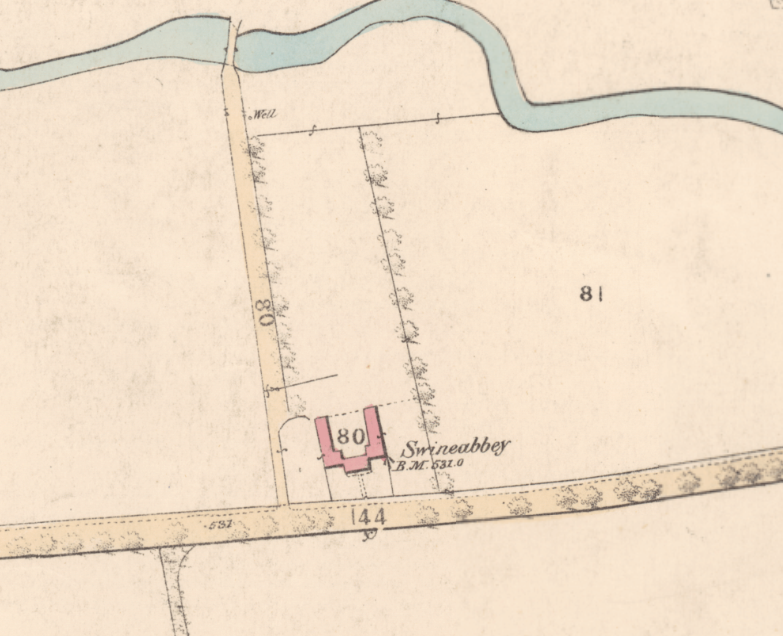
The History of Swineabbey
Despite what the name may indicate, the farm of Swineabbey was never a Monastically building nor was it a Pig farm. It s name is a phenetic adaptation of the Gaelic word ‘Sughan‘ meaning ‘Wet, Boggy or Marshland’ and ‘Abhainn’ which means ‘River’. So, ‘Sughan Abhainn’, which evolved into ‘Swine Abbey’ actually means a marshland by the river. This of course ties in correctly with the positioning of the farm just a couple of hundred yards from the River Almond behind it.
Its unsure exactly what year the steadings at Swineabbey were built. But we do know that it was a functioning Tavern that sat upon the Glasgow to Edinburgh Turnpike in the late 17th century. It had also been a well established Alehouse by the time of the 1684 covenanters ambush that happened there. The Building itself would have men built using local building materials which was mostly Sandstone and Limestone.
The Covenanters Ambush
During the turbulent ‘Killing times’ of the 17th century Covenanters wars, Swineabbey became the centre of events that proved to be quite a pivotal in the way the state handled the dissent of these ‘rebellious Covenanters’. The state had appointed various Royalist officers to deal with them. Amongst these was a corrupt constable named Thomas Kennoway. He was well known for Killing and torturing people for their money and belongings, using the reasoning that they were suspected covenanters.
On the Evening of November 20th, 1684, Kennoway arrived at the Inn with a sidekick Duncan Stewart, bragging about a list. It seemed that he had been given a Bounty list of men accused of being Covenanters for him to hunt down for the Bounty. To local covenanters overhearing this whilst discreetly listening from the background, saw this as a great threat. They knew that this could only mean One thing. – State sponsored slaughter of their own people. That same night, a group of covenanters ambushed Kennoway and Stewart and left them bludgeoned to death in the field out back.
The assassination at Swine Abbey provoked immediate, sweeping government retaliation. It also invoked the S act which hammered down on Covenanters. It made it illegal not to renounce the Covenant and anyone refusing to do so could be charged. Authorities ordered intense sweeps and searches across Edinburgh and the Lothians on November 29, 1684. This led to the capture and execution of prominent Covenanters, including Thomas Robertson, who was hanged at Gallowlee. It also brought an intensification of banishments to the American colonies.
The Twin-Arched Bridge
A defining surviving historical feature of the estate is the old twin-arched humpback stone bridge crossing the River Almond.
Depicted on early county maps, such as William Forrest’s 1818 map of Linlithgowshire, this elaborate stone structure linked the old Swineabbey farmstead to fields on the north bank of the river.
Notably, despite its substantial stone craftsmanship, historical records indicate it never carried a major public turnpike road. This suggests it either served as a vital private estate crossing or was part of a much older local route system predating detailed 18th- and 19th-century mapping.
Coal Mining and Industrial Heritage
Situated within West Lothian’s rich industrial heartland, the agricultural lands of Swineabbey sat directly atop deep, valuable mineral deposits. Like much of the surrounding area, underground coal mining actively took place beneath the Swineabbey estate seams through the 19th and 20th centuries, with documented underground extraction continuing until around 1958.
Mining subsidence and heavy industrial transport over the centuries reshaped the surrounding landscape, roads, and river crossings along the River Almond valley.
Swineabbey Today
Today, the original farm steading and farmhouse at Swineabbey have evolved into modern residential steadings and detached homes. Such as The Steadings and Ronoc Ridge. While the construction of the M8 motorway and the A801 link road in the late 1960s dramatically altered the old rural roads and valley views, Swineabbey retains its historical name and its quiet links to West Lothian’s tumultuous past.
What Do You Know?
Do you know something about the history of Swineabbey that we havent covered? We’d love to hear. Please let us know in the comments below or \by following the link below. Together we can work to create an accurate digital archive of our areas colourful History. So that everyone can benefit from a place they can come and find out whatever they want to know about the county’s rich heritage.