
Throughout the 18th century, the Scottish Lowlands underwent a ‘Great Improvement’ that saw a completely new era for Scotland and its lowlands. This agricultural revolution was a result of Scotland’s ‘Great Enlightenment’ that completely transformed West Lothian and the whole of Scotland in effect.
But what were the actual realities of this rural revolution? Well. lets have a look shall we?
The World Before the ‘Great Improvement’
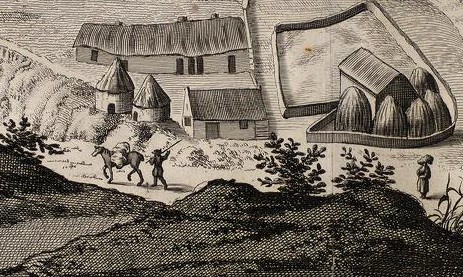
To walk through the modern Scottish Lowlands is to see a landscape of orderly, enclosed fields and efficient commercial hubs. But beneath this veneer of 19th-century industrial power lies the ghost of a vastly different world. In the 1670s, the land was a patchwork of “fermetouns”—communal settlements where land was managed collectively and the economy was driven not by the ledger, but by the land’s direct yield. Landlords would collect the rent in Kind, not cash.
How did a world of communally managed land, where rents were paid in live chickens, transform into the agricultural and industrial powerhouse of the 19th century? This was the era of “Improvement,” a period of radical upheaval that promised modernization but demanded a steep social price. It was a struggle for stability in a shifting economy, where the “relatable problem” of rising costs and changing labour demands was solved through methods that were both ingenious and, by modern standards, incredibly harsh.
Rent Wasn’t Always Money (And Landlords Liked It That Way)
Until the mid-18th century, the Scottish rental market operated on a system of fermes (grain consignments) and kain produce (live animals like chickens). While it might seem primitive, this system was a calculated strategic choice for the landed elite.
Landlords actually preferred receiving grain over cash. Before the Union of 1707, the Scottish currency was valued at a mere one-twelfth of sterling. Because the currency was frequently debased and devalued, holding “sufficient victual” was the ultimate hedge against market fluctuations and currency debasement. By collecting rent in kind, the landlord acted as the primary commercial gatekeeper, controlling the storage and eventual sale of surplus grain to growing markets in Edinburgh and Glasgow.
The 1656 “Assessment of Wages” for the Shire of Edinburgh provides a stark look at the labor required to maintain this system. It describes a “Whole Hind”—a skilled laborer—who had to be an expert in every facet of husbandry:
“A Whole Hind or Labourer of the Ground… should perfectly know everything belonging to husbandry… As to plough, to sow, to stack, to drive carts etc. He is commonly called a Whole Hind because he is to keep and to entertain with himself an able Fellow-Servant.”
This “Fellow-Servant” was a physical necessity; the Old Scotch Plough was a massive wooden beast that required a team of at least two men and multiple animals to navigate the soil. This system effectively kept tenants out of the market. The bridge between this world of chickens and the world of cash was the “Fiars” system—legally fixed annual prices of grain set in each county. These prices eventually allowed the “translation of obligations from grain to money,” but until the 1750s, the landlord remained the master of trade.
The “400% Rule”—Why Landlords Jacked Up Rents to Save the Farm
In the late 18th century, a new philosophy took hold, led by the tireless publicist Sir John Sinclair of Ulbster. Sinclair and his peers believed the Lowlands could only be modernized if tenants were forced to become “enterprising and independent.”
His radical prescription was the “fourfold rule.” Sinclair suggested that an optimum rent increase for an improving farm was 400% over a 30-year period. In a classic piece of historical irony, Sinclair actually described this radical hike as “moderate.” The logic was that high rents would act as a “tough love” catalyst, forcing tenants to adopt more efficient methods, regular liming, and better rotations just to stay afloat.
This wasn’t just theory. Records show that landlords hit these targets with startling precision:
- The Hamilton Estate: Scheduled “improved” rents rose to an average of 3.5 times the unimproved rate.
- The Yester Estate: Over intensive 30-year improving periods, average farm rents rose to just over four times the original rate, fitting Sinclair’s “optimum” exactly.
- The Castlemilk Estate: Some baronies saw revenue rise over 3.5 times in just 30 years (1731–1761).
The “Bondager” System—When a Woman’s Labour Paid the Rent
As the agricultural methods of the Lothians became the paradigm of pioneering improvement, a unique and controversial social hierarchy emerged known as the “Family System.” At the center was the “Hind”—a married, skilled farm servant living in a tied cottage on the farm.
However, the house wasn’t truly “free.” To pay the rent, a married hind was legally obligated to provide a female “outworker”—usually his wife or daughter—to perform seasonal field labor. These women were known as “Bondagers.”
The life of a Bondager was physically demanding and socially distinct. They were identified by their “uniform,” most notably the “Ugly”—a large sun bonnet made of gingham or cotton stretched over a cane framework. While the name suggests a lack of vanity, the bonnet served a specific sociological purpose: it protected the wearer’s skin from the wind and sun. In the 19th century, a fair complexion was a vital indicator of social status, and these women went to great lengths to preserve their skin while performing “men’s work.”
From Coal to Shale—The Birth of the Oil Age
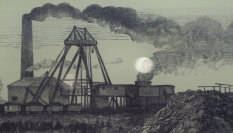
By the mid-19th century, the revolution shifted from the soil to the subsoil. In 1847, the chemist James Young noticed oil dripping from a coal mine roof, leading to the birth of the commercial oil industry. Young initially patented a method to extract oil from cannel coal in Bathgate.
When the cannel coal supplies were exhausted, Young pivoted to oil-bearing shale. In 1863, he moved his operations to the Addiewell Refinery, effectively launching the shale oil boom. West Lothian was transformed into an industrial landscape of mines and refineries, attracting a multi-ethnic workforce from the Highlands and Ireland.
Instant Cities, Instant Ruins—The Fragile Life of Shale Villages
This industrial surge sparked the phenomenon of “Lost Villages.” Towns like East Benhar and Oakbank were artificially created by mining companies almost overnight. They were built for one purpose: to house the workforce needed for the pits.
These were “tied” communities; the company owned the houses, the shops, and the schools. This created extreme vulnerability: losing your job meant immediate homelessness. Because these villages were built cheaply and intended only for the lifetime of the mine, they were fragile. When the shale industry collapsed in the 20th century, these villages were erased. Entire communities vanished from the map, demolished as soon as they were no longer “useful,” leaving only “spent shale bings” (waste piles) as their monuments.
The Great Improvement and the Price of Progress
The Scottish “Improvement” was undeniably successful in terms of efficiency, turning the Lowlands into an agricultural and industrial engine. However, that wealth was built on the “Lowland Clearances”—the dismantling of ancient “Fermetouns” and the loss of communal independence.
The price of progress was the displacement of thousands and the creation of a rigid “tied” labor system, shifting the population from communal settlements to isolated industrial rows. As we look at our own modern, “essential” industries, it’s worth considering the legacy of West Lothian. If we could look back 200 years from now, which of our current hubs of industry will have become a “lost village” or a pile of discarded shells?