West Lothian is a region whose very landscape was sculpted by the industrial revolution. From the rolling hills of Bathgate to the rugged moorlands of Fauldhouse, the history of this region is inextricably linked to the iron veins that once pumped lifeblood into its economy. The Railways of West Lothian represent a fascinating journey through time, charting the evolution of transport from primitive, pre-industrial mine tracks to the high-speed commuter networks of the present day.
Railways of West Lothian
Whether you are a local history enthusiast or a railway buff eager to explore vanished tracks, understanding the railways of West Lothian means understanding the soul of central Scotland. Let’s take a journey back in time to explore how the railways developed, thrived, vanished, and eventually returned to this historic county.
Pre-Industrial Roots: From “Medieval” Mines to Wooden Wagonways
When we think of railways, we naturally envision towering plumes of steam and heavy iron engines. However, the true ancestors of the railway system date back much further. In the medieval and early modern periods, West Lothian was already a site of shallow coal pitting and silver mining (such as the historic sites below Cairnpapple Hill).
To move heavy loads out of the dark, muddy environments of early mines, workers began laying down parallel wooden planks. By the 16th and 17th centuries, these basic tracks evolved into wooden “wagonways.” Horses were used to haul heavy carts along these guided timber rails, drastically reducing the friction and mud that bogged down traditional horse-drawn carts.
While the most famous early Scottish example is the neighbouring Tranent to Cockenzie Wagonway in East Lothian (built in 1722), West Lothian quickly adopted these methods to serve its growing coal and ironstone operations. These primitive wooden, and later cast-iron, tramways laid the foundational routes that the mighty steam locomotives would eventually conquer.
The Dawn of Steam and the Mainline (1840s)
The true railway age arrived in West Lothian in the 1840s, a period famously known as “Railway Mania.” Before the railway, transporting goods across the county meant relying on the Union Canal (opened in 1822) or slow, muddy turnpike roads. The railway changed everything, bringing unprecedented speed and connectivity.
The first major breakthrough was the Edinburgh and Glasgow Railway, which opened in February 1842. Routed through Linlithgow and Falkirk to avoid severe gradients, this line attracted businesses away from traditional stagecoaches, leaving towns that were bypassed struggling.
Recognizing that rail was the future, local landowners and businessmen campaigned fiercely for their own lines. In 1845, the Wilsontown, Morningside and Coltness Railway was established. This modest but vital goods line ran from a field near Longridge, passing close to Fauldhouse and Whitburn, carrying ironstone and coal west to the great furnaces of Lanarkshire. By 1849, after significant campaigning by local figures like Alexander Marjoribanks, Bathgate finally secured its own railway link to Edinburgh. The steam age had truly arrived, and the Railways of West Lothian were quickly expanding into a dense, interconnected web.
The Shale Oil Boom: A Network of Mineral Lines
If coal brought the railways to West Lothian, shale oil put them into overdrive. In the 1850s, pioneer James “Paraffin” Young established the world’s first commercial oil works in Bathgate, extracting paraffin oil from the region’s rich oil-bearing shale.
This geological quirk sparked a massive shale oil boom. To support the extraction and refining processes, an astonishingly dense network of mineral railways was woven across the county. Narrow-gauge and standard-gauge lines connected deep shale mines to immense refineries at Addiewell, Broxburn, and Pumpherston.
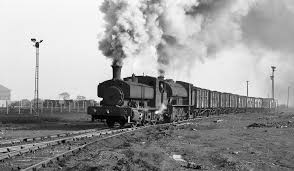
These industrial branch lines were not built for comfort or passenger travel; they were the grimy, hardworking arteries of the shale industry. Heavy goods trains rattled across the landscape day and night, assisted by rear-banking engines to push them up steep gradients near Armadale. The sheer volume of traffic meant that by the turn of the 20th century, Bathgate alone was the origin of around 50 coal and goods trains every single day. The waste product from this industry—the distinctive red “bings” (spoil heaps) that still dominate the West Lothian skyline today—was entirely moved and piled by these busy mineral railways.
Decline and The Beeching Axe
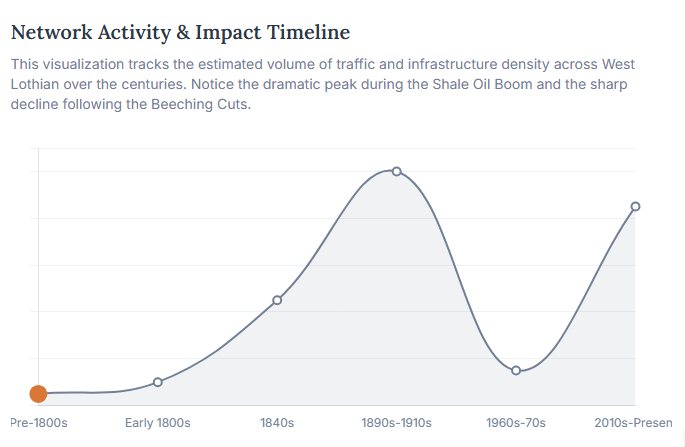
The golden age of the Railways of West Lothian reached its peak just before the First World War. However, the mid-20th century brought a slow and painful decline. The rise of the automobile, improved local bus services, and the slow death of the domestic shale oil industry (which finally ceased in 1962) meant that both passenger numbers and freight traffic plummeted.
Then came the infamous “Beeching Cuts” of the 1960s. Dr. Richard Beeching’s report on the reshaping of British Railways recommended the closure of thousands of miles of “unprofitable” track across the UK. West Lothian was hit exceptionally hard. Passenger services were withdrawn from towns like Whitburn, and historic stations were boarded up or demolished.
The construction of the M8 motorway in the 1960s served as the final nail in the coffin for many old branch lines, physically severing the routes that once carried the Wilsontown, Morningside and Coltness traffic. The tracks were ripped up, leaving behind silent, overgrown embankments and stone bridge abutments that disappeared into the woods.
The Modern Revival: Reconnecting West Lothian
Fortunately, the story of the Railways of West Lothian does not end in abandonment. As road congestion worsened toward the end of the 20th century, the value of rail travel was recognized once again.
In 1986, after decades without a station, passenger services triumphantly returned to Bathgate, reconnecting the town to Edinburgh. This proved so successful that a much larger, more ambitious project was launched two decades later. In 2010, the Airdrie-Bathgate Rail Link was completed, a major engineering feat that restored the missing link between Edinburgh and Glasgow via West Lothian. Today, modern, electrified commuter trains zip through newly built stations at Armadale, Blackridge, and Bathgate, serving a new generation of passengers.
Even the history of the old mineral lines is being preserved. At the Almond Valley Light Railway, volunteers and heritage buffs have built a working narrow-gauge railway to keep the spirit of the shale-era trains alive for visitors.
A Legacy Set in Stone and Steel
From the wooden cart tracks of the 1700s to the electrified lines of today, the Railways of West Lothian have perfectly mirrored the economic and social fortunes of central Scotland. They transported the coal that fuelled the nation, carried the shale oil that lit the world, and today, they carry the people who continue to call this historic county home.
While many of the original tracks have vanished into the undergrowth or been converted into peaceful walking paths, the legacy of these railways remains etched deeply into the landscape of West Lothian.