
If we take a look at an Old Parish map from 1855, just across the road from he Old halfway house to the West of Whitburn, we can see steadings named ‘Burnwind’. With the Turnpike Tollhouse on the Opposite side of the road alongside the Burnwind steading, its almost like a little hamlet on the main turnpike road between Glasgow and Edinburgh by Polkemmet. In the fact, it lay just a few yards to the East of the main gates to Polkemmet house.
The Mystery of Burnwind
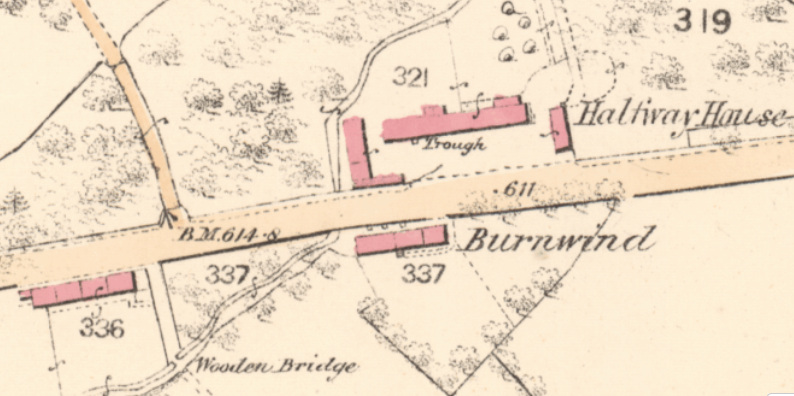
These gates are now the entrance to the Polkemmet Country park. If we go there today, we can still see the Halfway house standing strong. But what about Burnwind then? When we look at a slightly later map from only a few decades later in the late 19th century, there’s no sign of it at all. So, where did it just vanish to and how? Disappearing around this time would indicate that it was another One of the many casualties of the Lowland Clearances that came with the ‘Great Improvement’ of the late 18th and early 19th century.
What became of Burnwind?
At the turn of the 19th century, the Turnpike road upon which Burnwind sat, was part of what was still a relatively new road system and the area surrounding it was still very ,much thriving in the Great improvement of the Agricultural revolution. But as the century progressed , the noise of the Industrial revolution was drawing nearer. By the late 1800’s the Cult Estate and Polkemmet Estate had become hotbeds of Industry.
Many of the old rural settlements were swept away around this time to make way for Coal, Iron and Shale mining and extensive Lime and Sandstone Quarrying.
What was it?
So, I guess that in order to decipher what happened to the settlements at Burnwind, we must explore what they actually were. So, lets have a little look at that shall we?
A Lingering Fermetoun
Before the agricultural Improvements of the 18th century, the Lowlands of Scotland were scattered with hundreds of little villages called fermetouns. Many of these are still on the map today as working farms. But unlike your modern farm, the fermetoun was a collective effort that housed around 50 to 60 people. Most of these were swept away with the lowland clearances of the late 1700s and early 1800’s. But many lingered on until later before eventually being swept away by the rise of mining and quarrying in the area.
Short Lived Miners Rows
When the coal mining boom First took off across the lowlands of Scotland, many makeshift, red brick miners rows were thrown up. Most of these pits were only expected to last a short while. So the houses were pretty much brick tents. many were later dismantled and the bricks reused to built them up gain in a new area. So, Burnwind may well have been One of these rigs which would account for its absence later in the century.
Although, these were usually right next to the pit. The Cult Pit which later became the Dumback colliery did lie only a few Hundred yards to the South West of Burnwind. But it would seem unlikely that given the positioning of the settlement right outside the Gates of Polkemmet house, home of the Laird of the area, such residences would be built.
Revenues Cottages
Its a strong possibility that given their positioning to the Halfway House, that these were homes to the Governments Revenue officers that worked there. But, the hallway house wasn’t just a toll booth. It was a watering station for horses with a smithy and alehouse. So theres good chance that many of the workers here would have lived close by in these cottages. Theres also the possibility of them being residences of the Polkemmet House staff.
What do you think?
Well, what d you think? Do you have your own reckoning as to what this settlement of Burnwind was and what happened to it? Or maybe you know something we dont? Either way, why dont you let us know in the comments below.