
Perched on the rising slopes of the Bathgate Hills, Drumcross Farm embodies the dual identity of West Lothian’s landscape: an enduring agricultural community sitting directly atop a turbulent 19th-century industrial frontier. While today the surrounding fields present a quiet panorama of pasture and woodland, the lands of Drumcross and adjacent Drumcrosshall were once at the epicenter of Scotland’s frantic mineral rush and “oilmania”.
Drumcross Farm
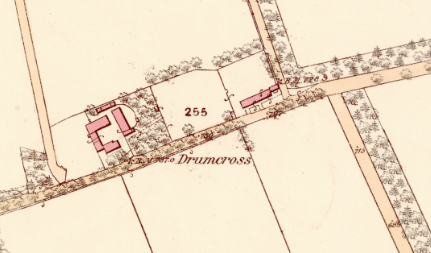
The name Drumcross derives from traditional Gaelic topography—druim signifying a hill ridge, marking the elevated terrain where the agricultural lowlands meet the volcanic uplands of Linlithgowshire (modern West Lothian). By the mid-18th century, estate surveys and estate plans began systematically mapping the farms along this corridor. In 1756, land surveyor William Cockburn recorded the farm of Drumcross under the tenancy of Alexander Lowrie, capturing an era when local farming relied on modest acreage and hardy livestock suited to the upland climate.
During the agricultural improvement movement of the early to mid-19th century, Drumcross transformed. Like many steadings across the Bathgate Hills, older linear thatch-roofed cottages were replaced or expanded into enclosed courtyard layouts. This central court design allowed cattle to be sheltered and fed over the harsh winter months. Built from local whinstone—an intractable, hard igneous rock quarried from nearby volcanic intrusions—the farmsteadings were roofed with imported Welsh slate and durable clay tiles, leaving a distinct Victorian architectural footprint that still survives in the stonework today.
The Black West: Coal, Shale, and “Oilmania”
While farmers tilled the whinstone soil above, mineral proprietors realized that the ground beneath Drumcross held immense wealth. Situated within two miles of Bathgate and closely linked to the expanding Edinburgh and Bathgate Railway network, the lands of Drumcross—owned in the mid-19th century by Andrew Kerr (Keir) and his trustees—were found to be rich in Smithy coal, Household coal, and Parrot (or Gas) coal, alongside high-grade fireclay.
However, it was the discovery of West Lothian oil-shale that brought frenzied industrial speculation to Drumcross. Following chemist James Young’s pioneering methods for refining paraffin oil from coal and shale, central Scotland was swept by “oilmania” in the 1860s. Around 1865, promoters Lester, Wyllie & Company leased mineral rights at Drumcross and erected the Drumcross Oil Works. Simultaneously, a second smaller crude paraffin plant was established nearby by James Palmer & Company.
Miners sank shafts at the Drumcrosshall No. 1 and No. 2 mines, extracting shale and coal to feed the retorts. The industrial boom, however, proved as volatile as the oil itself. Characterized by ill-conceived financial schemes and aggressive over-speculation, both Lester, Wyllie & Co. and James Palmer & Co. suffered catastrophic liquidity crises and were declared bankrupt by 1867. The Drumcross works were subsequently acquired by the larger Oakbank Oil Company Ltd and systematically dismantled around 1869 to 1870, bringing a swift end to the farm’s brief chapter as a refining center.
Tracing the Landscape Today
The physical scars of this industrial chapter have softened over a century and a half. Unlike the massive, towering red shale bings of Broxburn or West Calder, the spent shale and mining remnants at Drumcross were much smaller. Today, the site of the former oil works can still be identified by walkers and local historians as a subtle green mound rising from the boggy ground near the old mining lines—a quiet footprint of the 1860s oil boom reclaimed by nature.
Just beyond the farm boundaries lies Ravencraig Woodland, where remnants of stone ha-ha walls mark the boundaries of Lord Hopetoun’s 18th-century deer park. Together with nearby Bronze Age burial cairns and the limestone quarries of Petershill, Drumcross stands at a unique crossroads in West Lothian, where thousands of years of human activity are etched into a single square mile of countryside.
Chronology of the Drumcross Lands
| Era | Primary Activity | Key Historical Milestone |
| Pre-18th Century | Pastoral Farming | Early upland settlement along the volcanic hill ridges of Bathgate. |
| 1750s–1760s | Agricultural Improvement | Estate surveys document formalized tenancy and land boundaries under Alexander Lowrie. |
| 1830s–1850s | Steading Modernization | Construction of whinstone enclosed courtyard steadings for overwintering livestock. |
| c. 1865 | Industrial “Oilmania” | Lester, Wyllie & Co. open Drumcross Oil Works; shale and coal mines sink into the estate. |
| 1867–1870 | Bankruptcy & Dismantling | Speculative collapse leads to insolvency; Oakbank Oil Co. purchases and demolishes refining plant. |
| 20th Century–Present | Pastoral Reclamation | Mining mounds naturalize into green bings; farm returns fully to agricultural and residential use. |
The enduring whinstone walls of Drumcross Farm outlasted the smoke and speculation of the Victorian mineral boom. Serving as a living bridge between West Lothian’s agrarian roots and its industrial heritage, the farm remains a striking reminder of how rapidly the subterranean wealth of the “Black West” transformed—and was ultimately reabsorbed by—the rural landscape.