
West Bangour farm, Bangour, Dechmont, EH56
When we hear the place name ‘Bangour’ we usually think of the hospitals or the new housing development on the site of the Old village Hospital. Yet, West Bangour Farm is actually much older than both hospitals. But it sits thre quietly but not Invisible.
Let’s explore its history down through the ages including the coming and going of Two hospitals on its doorstep and explore how it still survives as an operational farm today.
West Bangour Farm
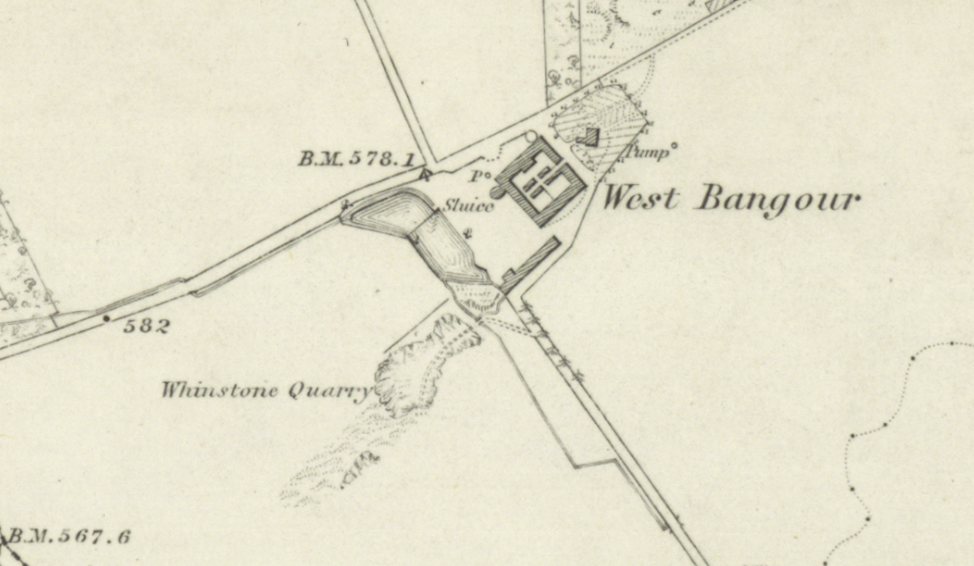
If you pass by the site of the Old Bangour Village Hospital on the A89, you will be sure to see the Old Farm of West Bangour. Its the One that looks like a castle at the top of the Long farm road that runs up the hill to the West Boundary of the wooded Hospital grounds. With its tall Shiloh commanding its presence on the landscape.
The History of West Bangour
But for most passers-by, West Bangour farm is simply a working agricultural property. Yet, the land beneath its steadings has witnessed an extraordinary evolution. From an aristocratic country estate to the agricultural engine for a pioneering psychiatric village, and finally outliving the massive hospital complexes built on its doorstep, West Bangour Farm is a testament to endurance.
Aristocratic Origins and Bangour House
The story of the farm begins with the wider Bangour Estate, which for centuries was the seat of the Hamiltons of Bangour. The most famous son of this lineage was William Hamilton (1704–1754), a celebrated Jacobite poet who lived at Bangour House.
The farm itself was built to serve this estate. During the agricultural revolutions of the 18th and 19th centuries, landowners across West Lothian began organizing their lands into planned farmsteadings. Constructed from the abundant local whinstone and sandstone, West Bangour Farm was originally built by the estate’s proprietors to supply Bangour House and generate agricultural wealth. Characterized by traditional cattle courts, barns, and eventually horse-driven threshing mills, it was a classic example of a self-sufficient Lothian estate farm.
While Bangour House has long since vanished, leaving no physical remains, the agricultural bones of the estate survived to see a radically different century.
A Radical Change: The Continental Colony
At the turn of the 20th century, the farm’s trajectory changed forever. In 1902, the Edinburgh District Lunacy Board purchased the 960-acre Bangour Estate. Their goal was revolutionary: to build a new kind of psychiatric institution based on the “Continental Colony” system—specifically modeled after the Alt-Scherbitz asylum in Germany.
Designed by architect Hippolyte Jean Blanc and officially opened in 1906, Bangour Village Hospital eschewed the monolithic, prison-like asylums of the Victorian era. Instead, it was built as a decentralized village of over 30 villas set in open parkland.
West Bangour Farm became the beating heart of this new community. The “colony” model relied heavily on occupational therapy. Patients were not confined; instead, they were put to work alongside staff in the bakery, the laundry, the workshops, and—most importantly—the farm. Working the land at West Bangour Farm gave patients structure, fresh air, and a sense of purpose, while simultaneously allowing the sprawling hospital to be entirely self-sufficient in meat, dairy, and produce.
War and the Two Hospitals
West Bangour Farm’s responsibilities only grew as global conflict reshaped the estate. Within a few decades, it found two distinct hospitals operating on its doorstep:
- Bangour Village Hospital: The original psychiatric facility, which continued its mission of rehabilitation through community and farm work.
- Bangour General Hospital: When the World Wars broke out, the Village Hospital was requisitioned for military use (handling up to 3,000 wounded soldiers by 1918). During the Second World War, a massive annexe was constructed on the grounds to serve as the Edinburgh War Hospital. After 1945, this annexe evolved into Bangour General Hospital, serving the wider West Lothian public with a world-renowned burns unit and a beloved maternity ward.
Throughout the mid-20th century, the farm operated at maximum capacity. Whether it was providing fresh food for recuperating tuberculosis patients or supplying daily provisions for the thousands of staff, soldiers, and civilians walking the grounds, West Bangour Farm was the lifeline of an immense medical complex.
The Departure of the Hospitals
The late 20th century brought the eventual decline of the Bangour hospitals. With the shift toward “Care in the Community” for psychiatric patients and the 1989 opening of the modern St. John’s Hospital in nearby Livingston, the sprawling Bangour complex became obsolete.
Bangour General Hospital was gradually run down and demolished in the early 1990s. Bangour Village Hospital slowly emptied out, with the final ward closing its doors in 2004. For years, the beautiful listed buildings of the Village Hospital sat abandoned, slowly decaying and occasionally being used as film sets (most notably for the 2005 Hollywood film The Jacket).
Surviving as an Operational Farm Today
Today, while the former hospital grounds undergo massive residential redevelopment to turn the historic site into a modern housing estate, West Bangour Farm remains a working agricultural property.
It has outlived the Hamilton’s who originally plotted its fields, the Lunacy Board that expanded its steadings, and the thousands of patients and doctors who once relied on its harvests. Returning to its roots as a quiet, functional farm in the Bathgate Hills, it stands as a living bridge to the past—a patch of West Lothian soil that has quietly fed and healed generations.