
The Back of Moss just to the East of the West Lothian Village of Longridge has withstood so many changes that have been taking place all around i. Thus, it has reserved some of the small space left in the area from pre Improvement Era of the 18th century.
Back of Moss
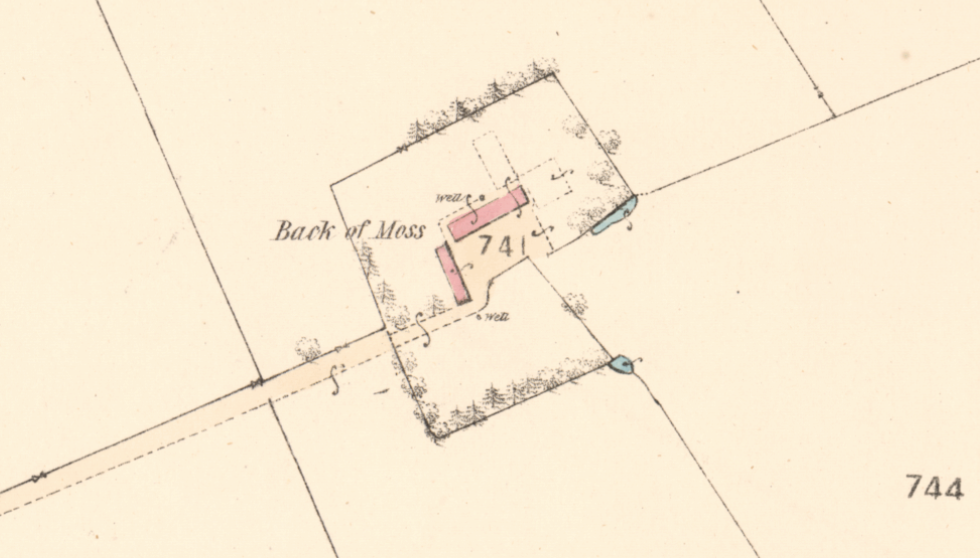
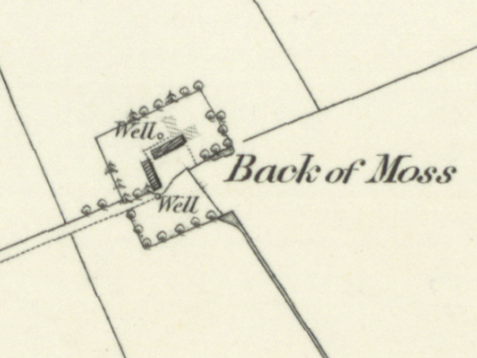
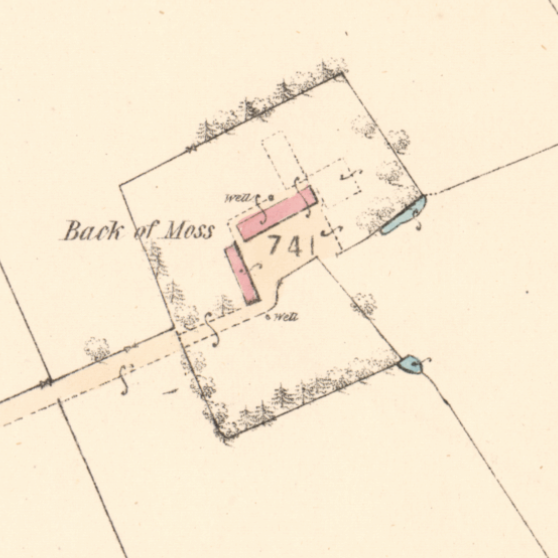
First Edition OS map, 1856
1855 Parish map
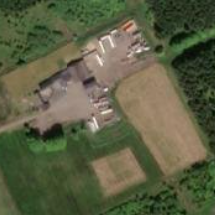
Aerial View of Back of Moss, 2026
Etymology
The name ‘Back o Moss’ is quite a deceptive name as it doesn’t actually refer to the ‘Back end’ OR ‘Rear’ of a property as it First sounds. But, Instead, It’s a mixture of generations of linguistic change and bastardisation. It was a mix of both ancient Celtic ‘Bac’ meaning Peat bog and ‘Moss’ which also means peat bog.
So, the literal translation actually means ‘Peat Bog of Peat Bog’. This generally refers to a peat bog area which has been long called this by First its old Celtic term and later by the English. This would have eventually be mixed with each other and eventually put on the map as Back o Moss’ giving it a sounding like it lies to the rear of a property.
The History of the Back of Moss
The farm on the site of The back of Moss has stood in its current place for centuries and has withstood both the Agricultural and Industrial revolution that engulfed the area surrounding it. Its unknown exactly when the farm itself was built but we do know from the records that there has been tenants living at Back of Moss since the early 19th century. We can also see from the records that Back o Moss wasn’t just a One family residence, but likely to have had Two or Three families living there at once with Lodging farm labourers as well.
Prentice Family
Census archives indicate that the lands were farmed as early as the first half of the 19th century. Archibald Prentice was a retired farmer who was born in Carluke in 1767. He is recorded as living at Back of Moss in the 1841 with his wife Janet and their 20 year Old Grandson John. However, as he was 70 years old at this point and retired, its likely that the farm would have already been under the management of Gillespie esq. But very probable that Back of moss had been run by Archibald prentice since the early 1820s.
A Later Census from 1851 describes an 84 year old widower Archibald Prentice living here with his daughter Agnes. She was born 1814 in Cambusnethan and died in Whitburn in 1902). Her son Absalom Kennedy also lived there. He was born 1844 in West Calder. So too did Archibald’s Granddaughter Janet Cadden who was born in Renfrewshire in 1845. David Tweedie was residing at the farm as a lodger in 1851. He and Agnes Prentice married shortly after, on 31 December 1852, in West Calder.
The Prentice family’s tenure highlights the deep-rooted agricultural continuity of Back of Moss. Archibald and his family worked this marginal land on the very edge of the wet, peat-rich Longridge Moss. Their presence in the 1840s and 1850s marks a key chapter in the transition of Back of Moss from a wild, peat-extractive landscape into a settled, multi-generational farming community, paving the way for later farming families
Gillespe family
An estate plan from the 1870s shows that the landowner of the Back o’ Moss lands was Gillespie Esp. The most notable detail of Gillespie’s tenure is a handwritten annotation on the 1870s plan: “Land owned by Gillespie Esq. – Minerals not let.” Even though the underlying geology of the estate belonged to the highly valuable coal measures series, Gillespie explicitly chose to hold onto the mineral rights and refused to lease them out
This simple legal restriction had a profound environmental consequence. While the surrounding landscapes of Longridge and Fauldhouse were heavily industrialised—carved up by coal pits, ironstone mines, and brickworks—the Back o’ Moss lands remained a completely undisturbed agricultural sanctuary.
Without Gillespie Esq.’s protective stance in the 1870s, the coal beneath Back o’ Moss would almost certainly have been extracted, reshaping the topography with shafts and bings. Instead, his decision preserved the rural integrity of the land, leaving it intact for subsequent farming families, and ultimately allowing the estate to undergo its modern ecological rebirth as a lowland crofting woodland community.
The Black family
By the late 19th century, the farm was worked by John Black. He was born here on the property in 1846. He is recorded in the 1881 and 1901 censuses as farming 90 acres at Back of Moss Farm.
ohn Black is recorded as the active farmer of these 90 acres in both the 1881 and 1901 censuses. This confirms a stable, continuous family tenure of at least twenty years spanning the end of the Victorian era and the turn of the 20th century.
Their quiet, stable dedication to the land stood in stark contrast to the surrounding landscape. During their tenure, the wider parish of Whitburn and the neighbouring moors of Fauldhouse were rapidly industrialising with coal pits, ironstone mines, clay quarries, and brickworks. Yet, thanks to the mineral restrictions maintained by the landowner Gillespie Esq., the Black family was able to farm their 90 acres undisturbed by the industrial chaos around them.
The Lowland Crofting Scheme
Today, the Back of Moss has been completely transformed from a struggling, marginal agricultural farm into a thriving, environmentally rich lowland crofting community. Instead of being developed into a standard suburban housing estate, the landscape now serves as a key model of West Lothian’s ecological and architectural rebirth.
Scenic Woodland :
Historically bare and bleak, the landscape is now blanketed by newly established native broadleaved woodlands. Under the council’s lowland crofting policy, at least 50% of the gross area has been permanently dedicated to forestry and biodiversity, turning the old farmland into a green haven of oak, ash, birch, and willow.
A Recreation Hub:
The area is a vital asset for local walkers, cyclists, and horse riders. It features a network of signposted, multi-use public paths winding through the peaceful woodland setting. This has successfully resolved Longridge’s historically fragmented greenspace network by providing “considerable new recreation access opportunities” that connect the village directly with the wider countryside.
Eco-Friendly Homes:
Tucked into the folds of the land is a small number of very low-density croft homesteads. These homes are highly regulated to preserve the rural character of the area. Built within dedicated building zones, they must be low, long, and narrow, positioned on a traditional east-west alignment to capture solar energy and match the natural topography of the ridge.
They are constructed using traditional materials like natural slate and tooled stone or wet-dash render. Modern suburban features (such as UPVC windows, block paving, and timber decking) are strictly prohibited to prevent the suburbanisation of the countryside.
Working Countryside:
The land is a carefully managed, “lived-in countryside”. Between 20% and 50% of the land remains retained as active agricultural fields. Residents use their spacious plots for hobby farming, keeping horses, or running small, non-intrusive home-based businesses.
Through this unique balance of native forestry, public access trails, and strictly controlled traditional homes, the Back of Moss functions as a complete, harmonious picture where human habitation and nature thrive side-by-side.
What do you Know?
Do you know something about the Back of Moss that we havent covered? We’d love to know. Why not tell us about it in the comments below. Or better still, send us your Info through the contact from in the link below here. We want to make the History hub as accurate as we can so that people may have a digita;l archive of West lothians history for years to come. A place where everyone can come and find exactly what they want to knw about or County’s colourful past.